

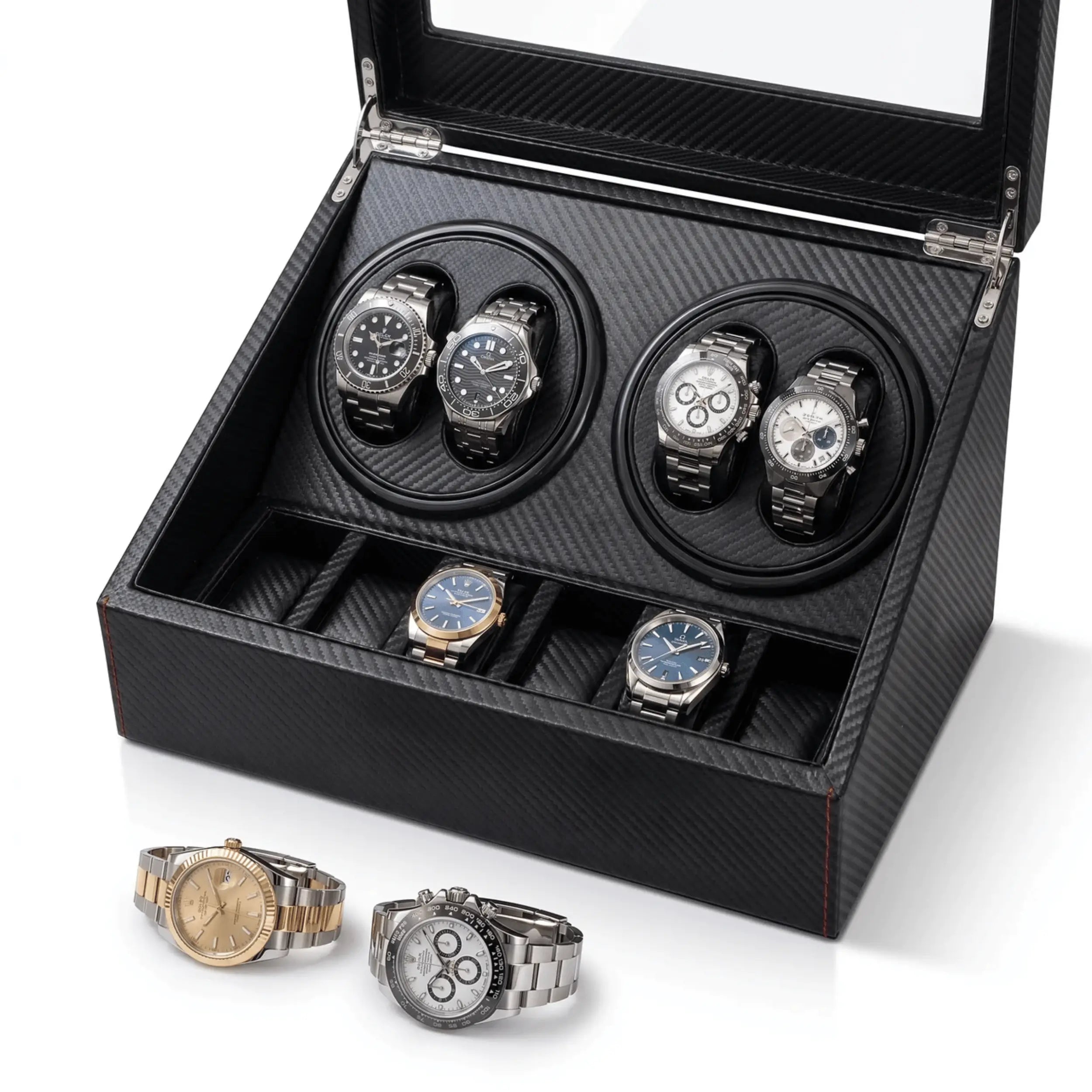
Watch winder: everything you need to know before buying
The debate over watch winders for automatic watches has divided the watch community for years. On one side, those who swear by keeping their collection running 24/7 and can't imagine going without. On the other, those who consider it a pointless gadget that wears out movements for no reason. This guide answers every question you have — and some you haven't thought of yet.
Is a watch winder worth it? A watch winder is useful if you own several automatic watches in rotation, or a watch with complications (perpetual calendar, moon phase, GMT). For a single watch worn every day, it offers no mechanical benefit. Quality is everything: a cheap model can do more harm than good.
Does an automatic watch need to be wound?
An automatic watch winds itself through the natural movement of the wrist. As long as it is worn for more than 8 hours a day under normal activity, it maintains its power reserve without manual intervention.
Manual winding becomes necessary in three situations:
- The watch has stopped for more than 40 to 72 hours depending on the calibre — 30 to 40 crown turns clockwise are enough to restore a useful power reserve.
- Physical activity is very limited — extended desk work, a day spent sitting — the rotor does not generate enough energy.
- Before wearing a watch that hasn't been used for several days — rather than waiting for it to wind up gradually on the wrist.
Is it okay to leave an automatic watch unwound?
Yes, with no mechanical risk. Contrary to a persistent misconception, letting an automatic watch stop and remain still does not damage it. Modern lubricants — synthetic since the 1990s — do not congeal during stops of several weeks or even months.
The argument that "oils congeal" applied to mineral lubricants used before the 1980s. It no longer applies to calibres manufactured since that era.
Key point: leaving an automatic watch stopped for several weeks or months causes no damage. Periodic servicing (every 5 to 7 years depending on the manufacturer) is independent of watch winder use.
Can you overwind an automatic watch?
No — at least not via a correctly set watch winder. All modern automatic calibres incorporate a slipping bridle mechanism that decouples the rotor from the mainspring once it is fully wound. The movement absorbs any excess energy without over-tension.
However, excessive manual winding of a manual winding calibre (without automatic mechanism) can break the mainspring bridle — a repair costing between $150 and $400 depending on the calibre.
Can you wind an automatic watch every day?
Yes, without risk. Manually winding an automatic watch each morning (30 to 40 crown turns) is common practice and entirely safe. It is even recommended for calibres that only wind in one direction — they benefit from a manual top-up during sedentary days.
How long can an automatic watch run without movement?
The power reserve of a modern automatic watch generally ranges from 38 to 80 hours. The most common values:
- 38 to 42 hours — ETA 2824, Sellita SW200, older Seiko calibres
- 48 to 55 hours — Miyota 9015, ETA 2892
- 70 hours — Rolex calibres 3235, 3255, 4130
- 72 hours and above — Omega Co-Axial 8500/8800, some manufacture calibres
- 8 days — large power reserve manual calibres (Panerai P.5000, IWC calibre 59210)
Beyond this duration without wearing or winding, the watch stops. It restarts without issue as soon as it is wound or placed back on the wrist.
Why use a watch winder for an automatic watch?
Three uses genuinely justify a watch winder:
- Rotating collection — if you own 3 or more watches worn in alternation, some will sit idle for several days. The winder keeps them ready to wear without resetting at each use.
- Complex complications — perpetual calendar, moon phase, equation of time. Resetting these complications after a stop can take 10 to 30 minutes and carries a real risk of incorrect setting. A perpetual calendar incorrectly set requires a watchmaker's intervention costing $300 to $800.
- Occasionally worn watch — evening dress watch, sports watch worn on weekends only. The winder eliminates the winding and setting ritual each time.

Are watch winders safe for watches?
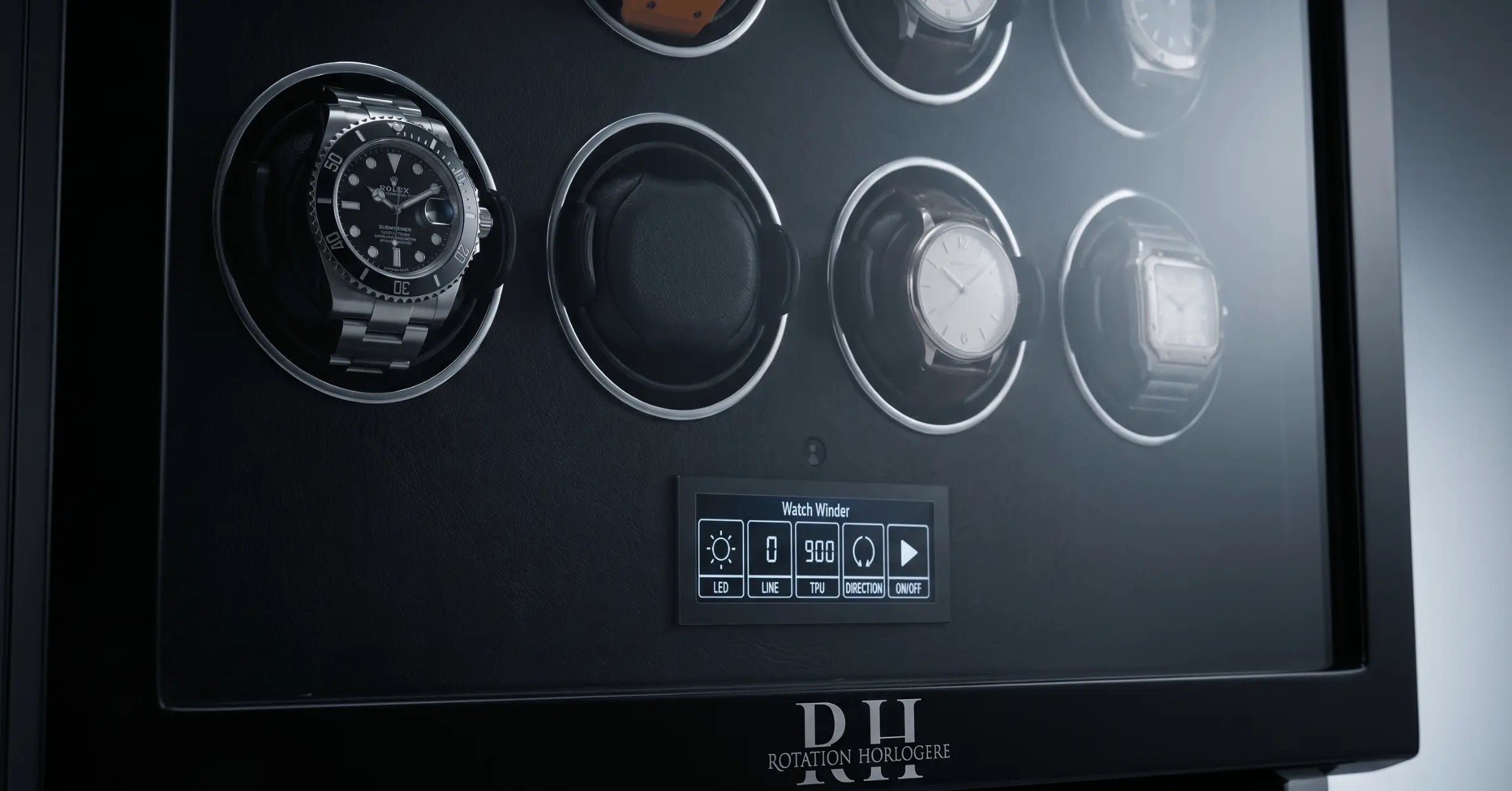
Yes, provided two criteria are met: a TPD (turns per day) suited to the calibre, and a motor with proper magnetic shielding.
The real watch community debate — summarised honestly:
- Argument for: the winder keeps the movement active, avoids stops and restarts, and preserves lubricant flow through the gear train.
- Argument against: a mainspring kept under constant tension continuously stresses the slipping bridle, generating cumulative friction inside the barrel — not dangerous short-term, but potentially increasing service frequency over very long periods.
The position of most professional watchmakers: for a simple watch worn daily, a winder adds nothing. For a rotating collection or a complicated piece, the practical advantages far outweigh this theoretical risk.
Can a watch winder magnetise a watch?
It is a real risk on cheap winders. The electric motor generates a magnetic field that can, without adequate shielding, affect the balance spring — the most sensitive component in the movement. A magnetised balance spring causes rate variations of several minutes per day.
Quality watch winders incorporate certified anti-magnetic shielding around the motor. This is one of the most important technical differences between a $50 model and one at $200 or more.
How much does a watch winder cost?
The market covers a very wide range:
- Under $50 — noisy generic motors, non-adjustable or inaccurate TPD, absent or insufficient magnetic shielding. Risk of failure within 6 to 18 months based on user feedback.
- $50 to $150 — acceptable entry-level quality for a simple watch. Often Chinese motor, adjustable TPD on some models. Suitable as a first purchase for a non-complicated watch.
- $150 to $400 — Japanese Mabuchi motors (industry reference), adjustable TPD, anti-magnetic shielding, refined finishes. Recommended level for a valuable watch.
- $400 and above — multi-watch models, biometric safes, solid wood finishes. For demanding collections.
Key point: the realistic floor price for a reliable watch winder for a valuable watch is around $150. Below that, the risk of premature failure or magnetisation is documented. Several forum users report replacing two or three Amazon winders before investing in a quality model — at a total cost higher than a good winder would have been from the start.
Are cheap watch winders effective?
Partially. A $40 winder makes the watch turn — in that sense, it "works." But three concrete limitations emerge quickly:
- Inaccurate TPD — the gap between the displayed TPD and actual rotations can reach 15 to 20% on cheap motors. Inconsequential on a simple watch, problematic on a complicated piece requiring precise settings.
- Noise — generic motors are significantly louder than Japanese motors. Multiple Reddit users report that their Amazon winders cannot stay in the bedroom.
- Lifespan — elastic drive belts, fragile plastics, motors not rated for continuous use: failures occur frequently within 6 to 18 months.
Why are some watch winders so expensive?
The price of a premium watch winder reflects concrete technical differences: Japanese Mabuchi motor (guaranteed under 10 dB, documented longevity), certified anti-magnetic shielding, precisely adjustable TPD, solid wood or genuine leather finishes, and long manufacturer warranty.
This is not a brand premium — these are components that cost more to produce. A Japanese motor costs 5 to 10 times more than a generic Chinese motor. Anti-magnetic shielding adds material and assembly cost. Over time, a quality watch winder costs less than replacing a succession of cheap models.
Is it okay to put a Rolex in a watch winder?
Yes, without restriction. Rolex does not advise against watch winder use in its official documentation. The recommended setting for the entire current Rolex range is 650 TPD in bidirectional mode (BOTH) — with the exception of Sky Dweller references 326xxx which require 800 TPD.
The only precaution: ensure the winder has effective anti-magnetic shielding. Modern Rolex calibres (32xx family and 4130) are robust, but the balance spring remains sensitive to intense magnetic fields.
Is it better to leave a watch on a winder or not?
It depends on your situation. A simple decision framework:
- Winder useful — you own 3 or more watches, or one of them has complications that are difficult to reset (perpetual calendar, moon phase, GMT).
- Winder unnecessary — you wear a single watch daily, or your watch only shows time and a simple date. Manual winding takes under two minutes.
- Winder inadvisable — if you are considering a model under $80 for a valuable watch. Better to let the watch stop than expose it to an unshielded motor or uncontrolled TPD.
How long should you leave a watch in a winder?
A watch winder is designed for continuous use. The watch can remain in it indefinitely when not being worn. Rotation and rest cycles are programmed automatically to alternate active and rest phases — there is no need to remove the watch between uses.
How long does it take to wind an automatic watch?
Via a watch winder, from a fully depleted power reserve: allow 24 to 48 hours to reach full charge, depending on the calibre and TPD setting. Via manual winding: 30 to 40 crown turns provide a useful immediate reserve (approximately 60 to 70% of maximum reserve depending on the calibre).
How much does an automatic watch service cost?
A full automatic calibre service costs:
- $250 to $500 for an ETA, Sellita or Miyota calibre at an independent watchmaker
- $400 to $800 for a mid-range manufacture calibre (Omega, TAG Heuer, Longines)
- $800 to $1,500 for a Rolex calibre at an official service centre
- $1,500 and above for high watchmaking manufactures (Patek Philippe, Audemars Piguet, Jaeger-LeCoultre)
Recommended service intervals vary by manufacturer: 5 years for Rolex, 3 to 5 years for Omega, 7 to 10 years for some manufacturers using long-life lubricants. Watch winder use does not significantly accelerate this interval.
How do you know if an automatic watch is fully wound?
On an automatic calibre, there is no firm stop comparable to a manual calibre. Two practical indicators:
- The seconds hand runs normally and turning the crown generates no more perceptible resistance — the slipping bridle is engaged.
- After 30 to 40 crown turns from a complete stop, the watch is at approximately 60 to 80% of its maximum reserve — sufficient for a normal day.
Do not look for a stop on an automatic: forcing beyond the perceived resistance is harmless (the slipping bridle absorbs it), but pointless.
What is the danger zone for setting the date on an automatic watch?
The window to avoid for any date adjustment is 9 PM to 3 AM. During this period, the date wheel gears are engaged preparing for the automatic midnight changeover. Forcing a date adjustment in this window can strip a tooth from the date wheel — a repair costing between $150 and $400.
To safely set the date: advance the hands past 6 AM (outside the automatic change zone), then use the crown's intermediate position to adjust the date.

Do I really need a watch winder?
The honest answer: probably not, if you wear a single automatic watch daily. A watch winder becomes relevant from 3 watches in rotation, or at the first demanding complication.
What Reddit users say after years of experience: those who own perpetual calendars or moon phases never go back. Those with a collection of simple watches split roughly evenly between "indispensable" and "I no longer use it."
One final concrete argument: the price of a quality watch winder ($150 to $250) is a fraction of the cost of a watch service. For a collection of 3 to 5 watches, the convenience value quickly outweighs the entry cost.
Key point: if you are still unsure, start by asking yourself this — how many times have you skipped wearing a watch because you had to wind it and set the date? If the answer is "often," a watch winder will change your relationship with your collection.
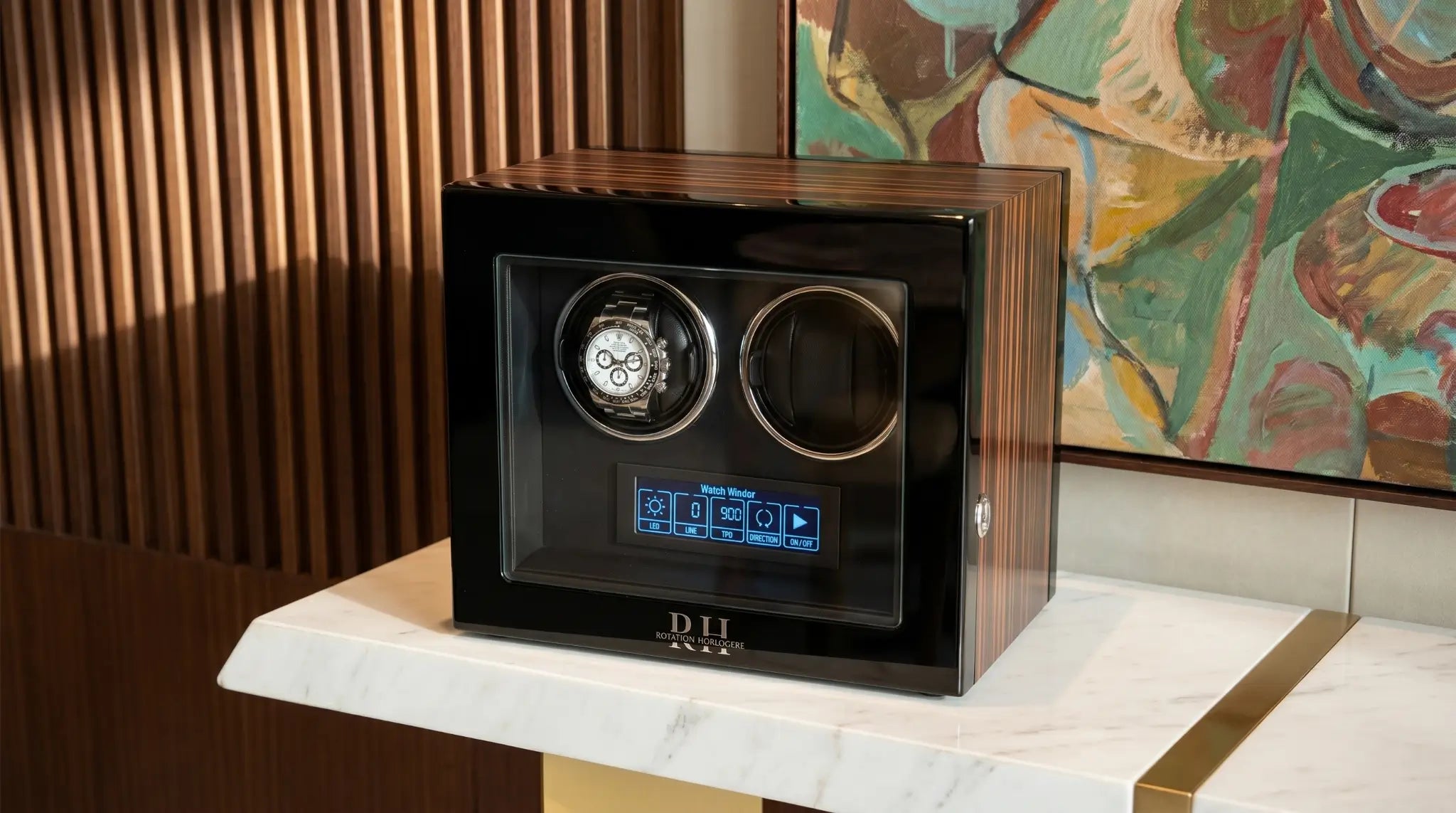
Watch winders — Rotation Horlogère · TPD guide by manufacturer · Watch winder for Rolex Daytona

Leave a comment
This site is protected by hCaptcha and the hCaptcha Privacy Policy and Terms of Service apply.