

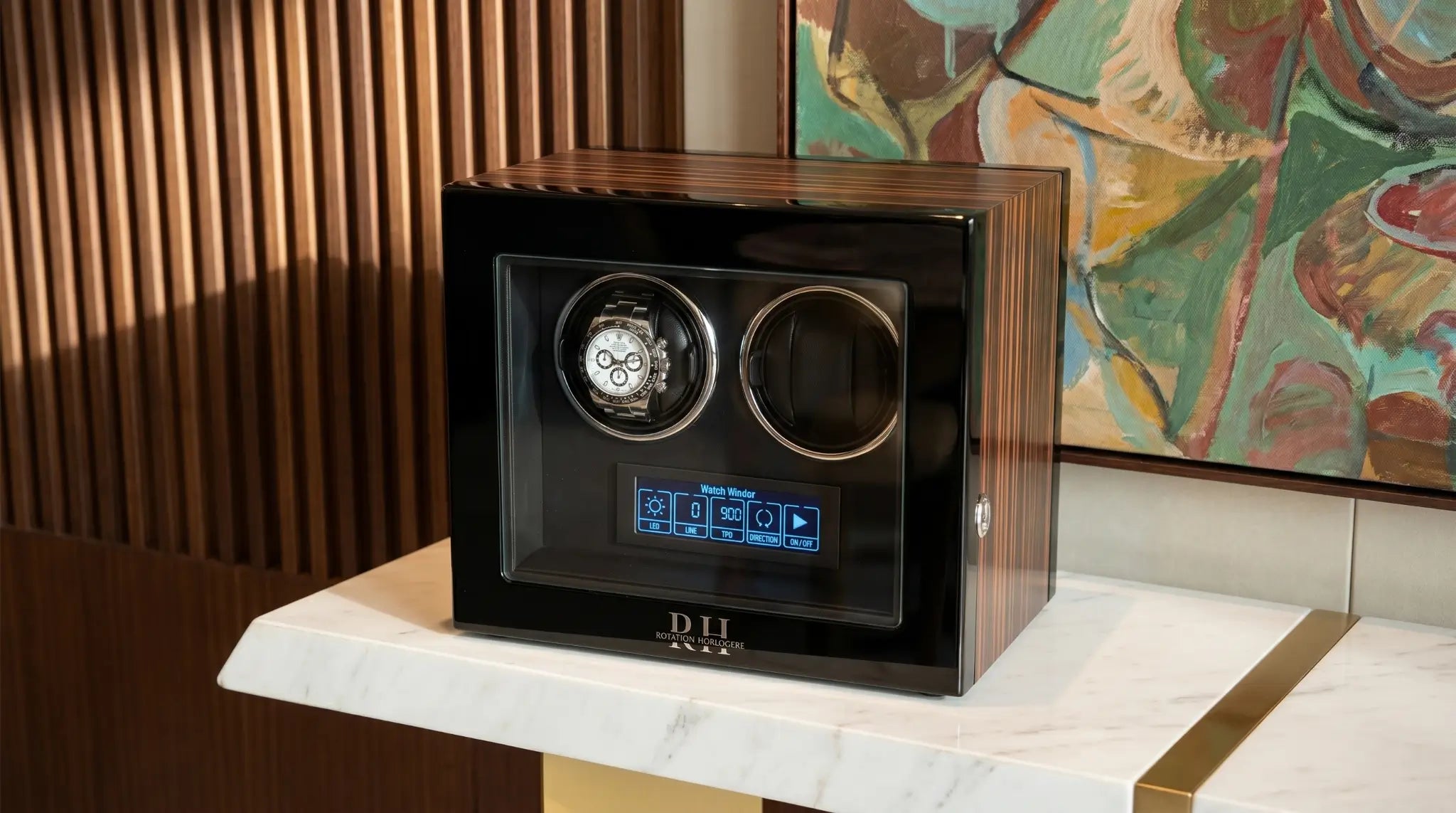
What is the best winder for an automatic watch?
Good to know: The best watch winder for an automatic watch is one whose TPD (Turns Per Day) and rotation direction exactly match the requirements of your movement. For the majority of luxury automatic watches (Rolex, Omega, Patek Philippe, Audemars Piguet), a winder adjustable between 650 and 850 TPD with bidirectional rotation is suitable. Capacity, quiet operation, and materials are secondary but crucial criteria depending on your use.
Do you own an automatic watch and are looking for the right winder? This guide gives you the keys to choose correctly — TPD, rotation direction, capacity, materials — along with our selection by collector profile.
Why does an automatic watch need a winder?
An automatic watch winds itself thanks to wrist movements. The rotor converts these movements into energy stored in the mainspring. Without regular wear, the watch stops in 38 to 72 hours, depending on its power reserve.
This is where the automatic watch winder comes in: it simulates wrist movement by keeping the rotor in programmed rotation. Without it, each stop requires resetting the time, date — and on watches with complications (moon phases, perpetual calendar, GMT), this resetting can take several minutes and unnecessarily stress the mechanism.
A poor-quality winder can cause movements that are too abrupt, leading to premature wear of components. A good winder protects your investment as much as your watch itself.
Key takeaway: An unworn automatic watch stops in 38 to 72 hours. A well-adjusted winder avoids repeated time settings that unnecessarily stress the mechanism — particularly critical for watches with complications.
The number one criterion: TPD (Turns Per Day)

Each automatic movement has its own winding requirements, expressed in TPD (Turns Per Day). A winder precisely adjustable to the correct TPD is essential — overwinding does not break the spring (the anti-overload device prevents it) but generates unnecessary vibrations on the components.
Recommended TPD by brand and caliber:
- Rolex Submariner / GMT-Master II (calibers 3235, 3285): 650–800 TPD · bidirectional
- Rolex Daytona (caliber 4130): 800–950 TPD · clockwise rotation preferred
- Rolex Datejust (calibers 3235, 2236): 650–800 TPD · bidirectional
- Omega Seamaster / Speedmaster (calibers 8500, 8800, 1120): 650–800 TPD · bidirectional
- Patek Philippe Nautilus / Calatrava (calibers 240, 324, 5711): 650–800 TPD · bidirectional
- Audemars Piguet Royal Oak (calibers 3120, 4302): 650–800 TPD · bidirectional
- IWC Big Pilot / Portugieser (calibers 52010, 30110): 650–900 TPD · bidirectional
- Breitling Navitimer / Superocean (calibers B01, B04): 800–950 TPD · bidirectional
- Jaeger-LeCoultre Reverso / Master (calibers 896, 939): 650–800 TPD · bidirectional
- TAG Heuer Carrera / Monaco (calibers Heuer 02, CAL5): 650–800 TPD · bidirectional
Consult our complete TPD Guide by manufacturer for all calibers.
Key takeaway: For most luxury automatic watches, a setting between 650 and 850 TPD with bidirectional rotation is optimal. The Rolex Daytona caliber 4130 is an exception: it prefers clockwise rotation at 800–950 TPD.
The 5 essential criteria for choosing your watch winder
1. The direction of rotation
Three options: clockwise, counter-clockwise, bidirectional. The vast majority of modern movements operate bidirectionally. Always choose a winder offering all three options for maximum compatibility with any evolution of your collection.
2. Capacity — planning for growth
The rule: always buy a capacity greater than your current collection. A collection of 2 watches often becomes 4 or 6 in 18 months.
- 1 to 2 watches: 2 or 4-slot winder
- 3 to 5 watches: 6-slot winder
- 6 to 10 watches: 8 or 12-slot winder
- More than 10 watches: 12 to 24-slot winder or modular solution
3. Quiet operation
A winder placed in a bedroom must operate below 20 dB — comparable to an empty room. High-quality DC motors with anti-vibration suspension guarantee this silence. Japanese motors (Mabuchi, Nidec) are the industry standard: reliable, quiet, durable.
4. Materials
- Wood (walnut, pear, bamboo): classic elegance, natural acoustic insulation, sensitive to humidity
- Leather: luxurious appearance, soft for watches, regular maintenance
- Metal (stainless steel, aluminum): maximum durability, contemporary aesthetic
- Carbon fiber: lightness, technical appearance, ideal for sports watches
The best winders combine several materials: noble wood exterior, leather or suede interior, metal finishes.
5. Power supply
Mains (constant reliability) or batteries (placement flexibility). Hybrid systems offer the best of both — continuity in case of power outage.
Our selection by collector profile
Beginner — 1 to 3 automatic watches
A compact, versatile winder with adjustable TPD and rotation direction. The essentials without excess.
→ See our 1 to 4 watch winders
Experienced collector — 4 to 8 watches
A winder with independent heads with TPD adjustment per slot. Essential when mixing brands with different requirements — Rolex (650–800 TPD) + Breitling (800–950 TPD) + IWC (650–900 TPD) in the same box.
→ See our 4 to 8 watch winders
Demanding enthusiast — 8 to 12 watches and more
A high-end winder with ultra-quiet motors, premium finishes, integrated security (lock, biometrics). The value of the collection justifies a commensurate investment.
→ See our 8 to 24 watch winders
Heritage collection — security above all
As soon as your collection exceeds €10,000, a winder alone is no longer enough. A safe winder combines programmable winding and physical protection — the solution for tourbillons, perpetual calendars, and rare pieces.
Additional features
LED lighting
Good LED lighting highlights watches without harmful radiation to the dials. Modern LED systems consume little and generate minimal heat.
Locking system
For collections in professional or accessible spaces: traditional key, numeric code, or biometrics. See our range of safe winders with biometrics.
Connectivity
The most innovative models allow controlling parameters via smartphone and programming personalized cycles per slot — useful for large collections with very different calibers.
Maintenance of your winder
- Weekly: exterior dusting
- Monthly: cleaning of accessible parts
- Annually: for wooden winders, treatment with appropriate product
- Every 3 to 5 years: professional review — motors, lubrication, settings
A quality winder is guaranteed for 2 to 5 years. This is a reliable indicator of the manufacturer's confidence in its product.
FAQ — Automatic watch winder
Can a winder damage an automatic watch?
No, if the TPD and rotation direction are correctly set. All modern automatic watches include an anti-overload device that prevents excessive mainspring tension. The real risk comes from a winder with overly abrupt movements (poor quality motor) or excessively high TPD that generates unnecessary vibrations.
Can a watch be left on a winder permanently?
Yes, provided the winder alternates rotation cycles and rest periods. Continuous 24/7 cycling without a break is not recommended — the watch should be able to "rest" for a few hours a day, as it would naturally on the wrist.
How many TPD for a Rolex?
For most modern Rolexes (Submariner, GMT-Master II, Datejust), a setting of 650 to 800 TPD with bidirectional rotation is suitable. The Daytona caliber 4130 is an exception: it prefers clockwise rotation at 800–950 TPD. Consult our complete Rolex TPD Guide.
Which winder for a Patek Philippe?
Patek Philippe calibers (240, 324, 5711) operate between 650 and 800 TPD with bidirectional rotation. Patek is particularly sensitive to vibrations — choose a winder with a Japanese Mabuchi or Nidec motor and integrated anti-vibration suspension.
Silent winder: how many decibels should I aim for?
Below 20 dB — comparable to an empty room. Winders equipped with Japanese DC motors (Mabuchi, Nidec) with anti-vibration dampening consistently achieve this level. Above 30 dB, the noise becomes perceptible in a silent bedroom.
What is the difference between a 1-watch and 6-watch winder?
Beyond capacity, 6-watch winders and larger generally offer independent heads with individual TPD adjustment per slot — essential for mixed collections. 1- or 2-watch winders often have a single global setting.
Do I need a winder for each watch?
No. A multi-slot winder with independent heads is sufficient. The key is that each head is individually adjustable to meet the specific requirements of each movement.
Winder or safe winder: which to choose?
If your collection exceeds €10,000 in total value, a safe winder is necessary. It combines programmable winding and physical protection against theft. Below this threshold, a quality classic winder is sufficient.
Checklist for choosing your watch winder
- Number of current watches + 18-month projection
- Required TPD for each caliber in your collection
- Rotation direction (bidirectional recommended for most)
- Independent heads if mixed collection (different brands)
- Intended location: bedroom → silence priority, office → aesthetics
- Power supply: mains or batteries depending on configuration
- Security: collection > €10,000 → safe winder
- Budget: proportional to the value of the watches being protected
To go further: Complete TPD Guide by manufacturer · Our range of automatic watch winders · Safe watch winders

%20and%20rotation%20direction%20exactly%20match%20the%20requirements%20of%20your%20movement.%20For%20the%20majority%20of%20luxury%20autom...)
Leave a comment
This site is protected by hCaptcha and the hCaptcha Privacy Policy and Terms of Service apply.