

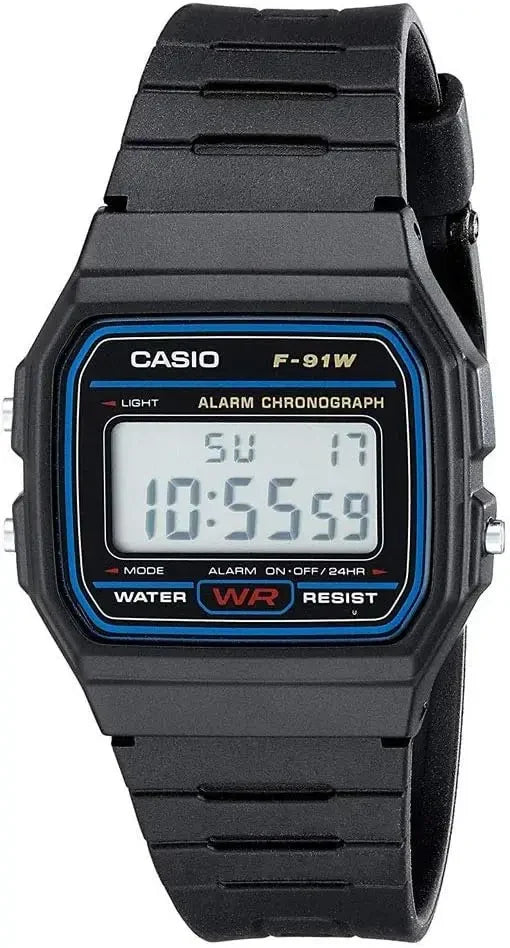
What is the best-selling watch in the world?
What is the best-selling watch in the world? The answer surprises everyone: it's not a Rolex, not an Apple Watch, not even a Seiko. It's a $12 digital watch launched in 1991 that has sold over 150 million units. The Casio F-91W is the best-selling watch in history — and its reign shows no sign of slowing down. If you own automatic watches alongside your F-91W and are looking for a watch winder, read on — we cover those too.
What is the best-selling watch in the world? The Casio F-91W — over 150 million units sold since 1991, at under $15. Not a Rolex, not an Apple Watch: a Japanese digital watch launched over thirty years ago, still in production, still on top.
The Casio F-91W: numbers and data
The F-91W was launched in 1991 by Casio, a Japanese manufacturer founded in 1946. Over thirty years of uninterrupted production, it has become the most widely distributed timepiece in the history of watchmaking — across all categories.
- Launch price: approximately $9 in the United States in 1991, stable at $12–15 today worldwide.
- Battery life: 7 years under normal use — one of the best longevities on the market.
- Weight: 21 grams including case and strap, one of the lightest watches available.
- Water resistance: 30 meters — sufficient for daily use and rain exposure.
- Movement: Casio W-59 quartz module, accuracy ±15 seconds per month.
- Dimensions: 38.2 × 33.2 × 8.5 mm — a unisex format worn by children and adults alike.

Why is the F-91W the best-selling watch in the world?
Three structural reasons explain this record.
Price. At under $15, the F-91W is accessible in every global market — including lower-income countries where it is often the first watch ever purchased. No mechanical watch, no smartwatch can compete on this ground.
Durability. Generations of users report lifespans of 10 to 20 years with zero maintenance. The resin case absorbs shocks, the battery lasts 7 years, and the quartz module operates reliably in extreme temperature and humidity conditions.
Universal design. The F-91W is worn by schoolchildren, military personnel, astronauts, heads of state, and artists. Its minimalist 1991 design has barely aged — making it a retro fashion accessory as much as a timekeeping tool.
Notable fact: the F-91W has been worn in space by NASA astronauts, used by special forces units across multiple armies, and photographed on the wrists of Barack Obama, musicians, and artists across three decades. Its cross-cultural reach is unmatched in the watch industry.

Best-selling watches in the world: ranked by volume
Exact sales figures are rarely published by brands. The estimates below compile available data from analyst reports, industry studies, and brand communications.
| Watch | Category | Estimated cumulative sales | Retail price |
|---|---|---|---|
| Casio F-91W | Digital | 150 million+ | $12–15 |
| Casio G-Shock DW-5600 | Sport/digital | 100 million+ | $80–120 |
| Swatch (all references) | Quartz analog | 500 million+ (group total) | $80–200 |
| Apple Watch (all series) | Smartwatch | 250 million+ since 2015 | $299–799 |
| Seiko 5 (all references) | Entry-level automatic | 50 million+ estimated | $150–400 |
| Rolex Submariner | Luxury automatic | ~1 million/year (annual production) | $10,000–16,000 |
F-91W vs Apple Watch: volume vs value
The Apple Watch has been the best-selling watch by revenue since 2019 — Apple's watch division alone generates more revenue than the entire Swiss watch industry combined. By unit volume, it does not rival the F-91W: approximately 50 million Apple Watches are sold annually, compared to a Casio production run that is difficult to quantify but estimated at several tens of millions of F-91W units per year.
The two watches serve radically different purposes. The Apple Watch requires daily charging, a compatible iPhone, and an implicit subscription to the Apple ecosystem. The F-91W runs for 7 years without intervention. In markets with limited electrical infrastructure, the F-91W holds a structural advantage no smartwatch can overcome.
The F-91W in popular culture
Few watches have generated as many documented stories for a $12 object:
- NASA: several astronauts carried their personal F-91W on space missions, as a backup timepiece or for daily use in weightlessness.
- Special forces: documented in the equipment of soldiers from multiple armies, valued for its low profile and resistance to extreme conditions.
- Hip-hop and punk culture: worn by artists from the 1990s through the 2020s as a symbol of anti-conformism against luxury watches.
- Barack Obama: photographed on multiple occasions wearing an F-91W during his presidency.
F-91W vs automatic watches: which watch for which use?
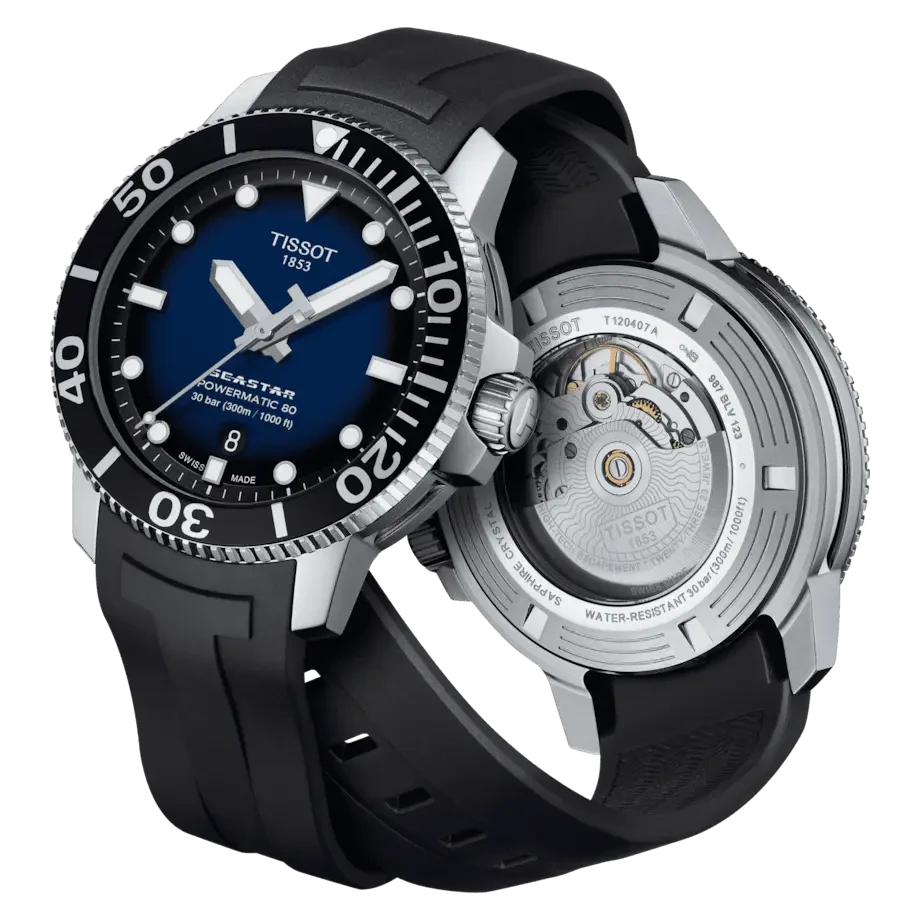
The F-91W is a digital quartz watch — it has no mechanical movement and never needs winding. At the other end of the spectrum are automatic watches, whose movement is maintained by wrist motion or by a watch winder.
The two categories serve different audiences:
- Casio F-91W — absolute timekeeping tool, ±15 seconds/month accuracy, zero maintenance, universal price point.
- Automatic watch — mechanical object, ±5 to 15 seconds/day accuracy, service every 5 to 7 years, heritage value.
For collectors owning several automatic watches, a watch winder keeps movements running between wears — avoiding the tedious resetting of complications such as perpetual calendars or moon phases.
FAQ
What is the best-selling watch in the world in 2024?
The Casio F-91W remains the best-selling watch by cumulative volume. By annual revenue, the Apple Watch has dominated since 2019. By annual unit volume, estimates consistently place the F-91W and other Casio models at the top of the global market.
How many Casio F-91W units have been sold?
Casio does not publish official figures. Industry estimates place cumulative sales since 1991 at over 150 million units, making it the most widely distributed individual watch model in history.
Is the Rolex Submariner the best-selling luxury watch?
The Submariner is consistently cited as the best-selling automatic luxury watch — approximately 1 million units per year according to watch market analyst estimates. It remains far behind the F-91W in volume, but is the absolute reference in the accessible luxury segment.
Is the Casio F-91W a good watch?
For its purpose — telling time accurately under all conditions, with zero maintenance, at minimal cost — yes. Its quartz accuracy (±15 seconds per month) exceeds that of a mechanical movement without chronometer certification. Its 10 to 20-year lifespan is documented by thousands of users worldwide.
Why is the Casio F-91W so popular?
Three factors: a universal price point (accessible in every global market), exceptional durability (7-year battery, resin case), and a timeless design that has crossed three decades without aging. Its cross-cultural reach — from primary school to special forces — is unmatched in the watch industry.
What is the difference between the Casio F-91W and the G-Shock?
The G-Shock is the reinforced, sport-oriented version of the Casio concept: shock-absorbing resin case, water resistance up to 200 meters, additional functions (stopwatch, multiple alarms, compass on select models). The F-91W is more compact, lighter, and less expensive. Both share a reliable Casio quartz movement and exceptional battery life.
Watch winders for automatic watches · TPD guide by manufacturer

Leave a comment
This site is protected by hCaptcha and the hCaptcha Privacy Policy and Terms of Service apply.