

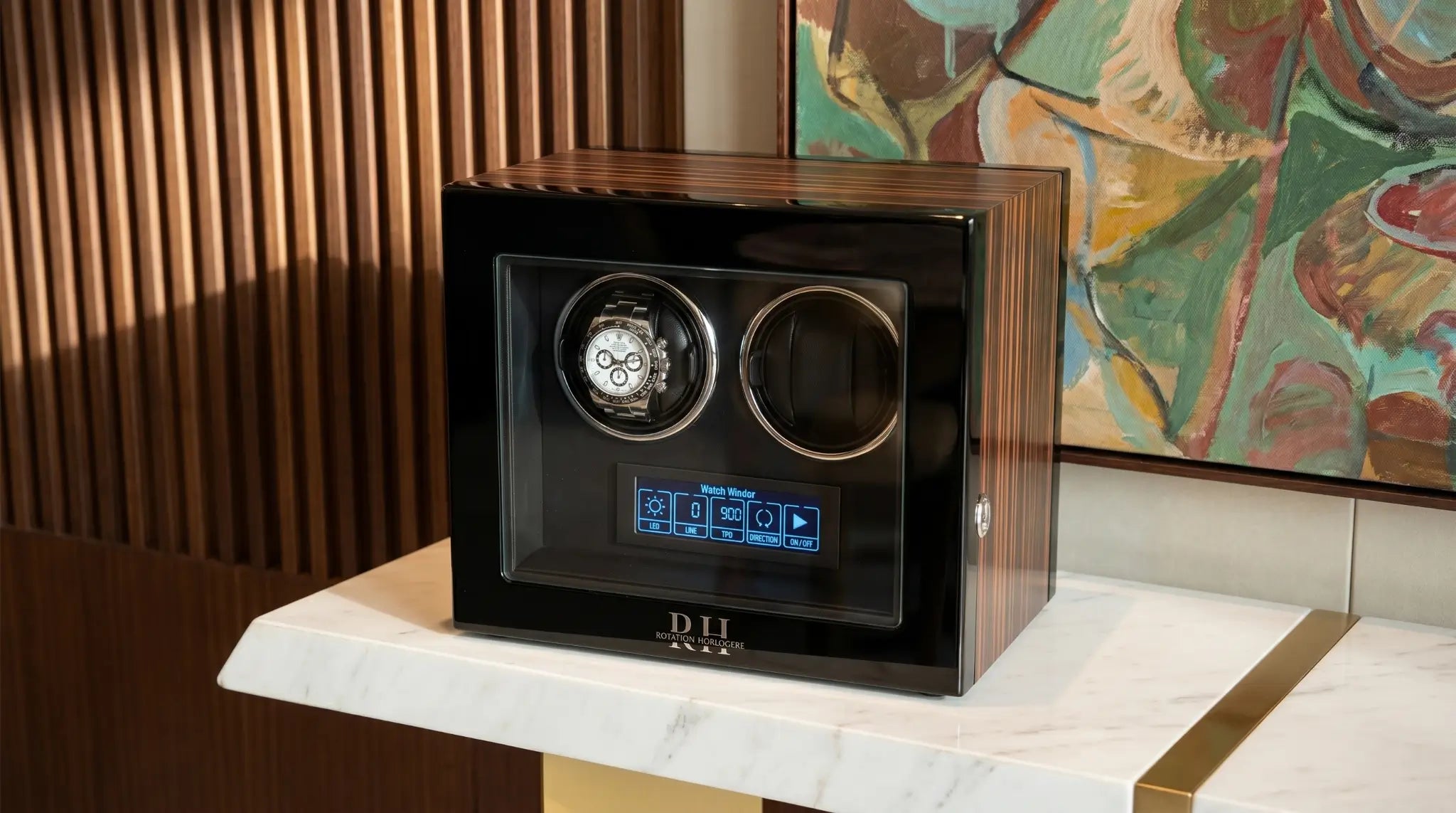
Which watch winder for a Rolex Daytona? TPD setting and caliber 4130
The Rolex Daytona is the most coveted automatic chronograph on the secondary market. Its Calibre 4130 — a Rolex in-house movement since 2000 — brought an end to the Valjoux 72 era and redefined what is expected from winding via an automatic watch winder. Only one setting is needed. But you still need to know which one, and why.
Short answer: The Rolex Daytona Calibre 4130 winds at 650 TPD in bidirectional (BOTH) mode. This setting applies to all modern Daytona references, from the 116500LN to the 126529LN. There are no official exceptions documented by Rolex.
The Calibre 4130: What You Need to Know
The current Daytona features the Calibre 4130, an in-house Rolex movement entirely developed internally and introduced in 2000 on reference 116520. It is the first chronograph calibre Rolex designed from scratch, replacing the Valjoux 72 used until the 1980s.
The 4130 has several structural characteristics that directly influence the choice of winder:
- Power reserve: 72 hours — superior to the average of the Rolex range (70h for 32xx calibres).
- Bidirectional rotor — the rotor recovers energy in both directions of rotation, like all modern Rolex watches.
- Vertical chronograph mechanism — Rolex's own vertical clutch, more precise and less prone to hand jumps than traditional horizontal clutches.
- 290 components — compared to 350 to 400 for a conventional column-wheel chronograph. This simplification improves long-term reliability on a winder.

Recommended TPD Setting for the Daytona
Rolex standardizes its entire range to 650 TPD in bidirectional (BOTH) mode. The Daytona — all references included, from 116520 to 126529LN — is no exception. This setting applies to the Calibre 4130 regardless of case or bracelet.
Daytona Setting. 650 TPD, BOTH mode (bidirectional). Applicable to all Daytona references equipped with Calibre 4130: 116500LN, 116505, 116506, 116508, 116518LN, 116519LN, 126500LN, 126503, 126505, 126506, 126508, 126515LN, 126518LN, 126519LN, 126529LN. For complete specifications of the Rolex range, consult the Rotation Horlogère TPD Guide.
| Model | Reference | Calibre | Direction | TPD |
|---|---|---|---|---|
| Daytona steel ceramic bezel | 116500LN / 126500LN | 4130 | BOTH | 650 |
| Daytona yellow gold | 116508 / 126508 | 4130 | BOTH | 650 |
| Daytona white gold | 116509 / 126509 | 4130 | BOTH | 650 |
| Daytona Everose gold | 116505 / 126505 | 4130 | BOTH | 650 |
| Daytona platinum | 116506 / 126506 | 4130 | BOTH | 650 |
The Debate on Rotation Direction: BOTH or CW?
On several watch forums — particularly WatchUSeek and the Reddit communities r/Rolex and r/WatchHorology — a question regularly arises: wouldn't the Calibre 4130 prefer exclusively clockwise (CW) rotation rather than bidirectional?
The argument is based on an analysis of the geometry of the 4130's winding system, where the rotor would transmit energy slightly more efficiently in the clockwise direction. Several owners report having achieved better results with a CW setting.
What the data says. Rolex does not publish any differentiated recommendations for the Calibre 4130. All reference technical databases — including that of Rotation Horlogère, which covers 314 Rolex references — classify the Daytona as BOTH 650 TPD. The CW vs. BOTH debate is based on community observation, not official technical documentation. A CW 650 TPD setting presents no mechanical risk and can be tested without fear.
Which Winder to Choose for a Daytona?
The Daytona is rarely alone. It often shares space with one or more other Rolex watches — Submariner, GMT-Master, Sky-Dweller — whose TPD settings may vary. The ideal winder for a Daytona is one that allows independent programming per watch.
For a Solo Daytona
An individual winder with adjustable TPD is sufficient. The 650 BOTH setting is applied once, and the watch is kept running continuously. The Diplomate is designed for this profile: discreet, silent, TPD adjustable via touch screen.
For a Mixed Rolex Collection
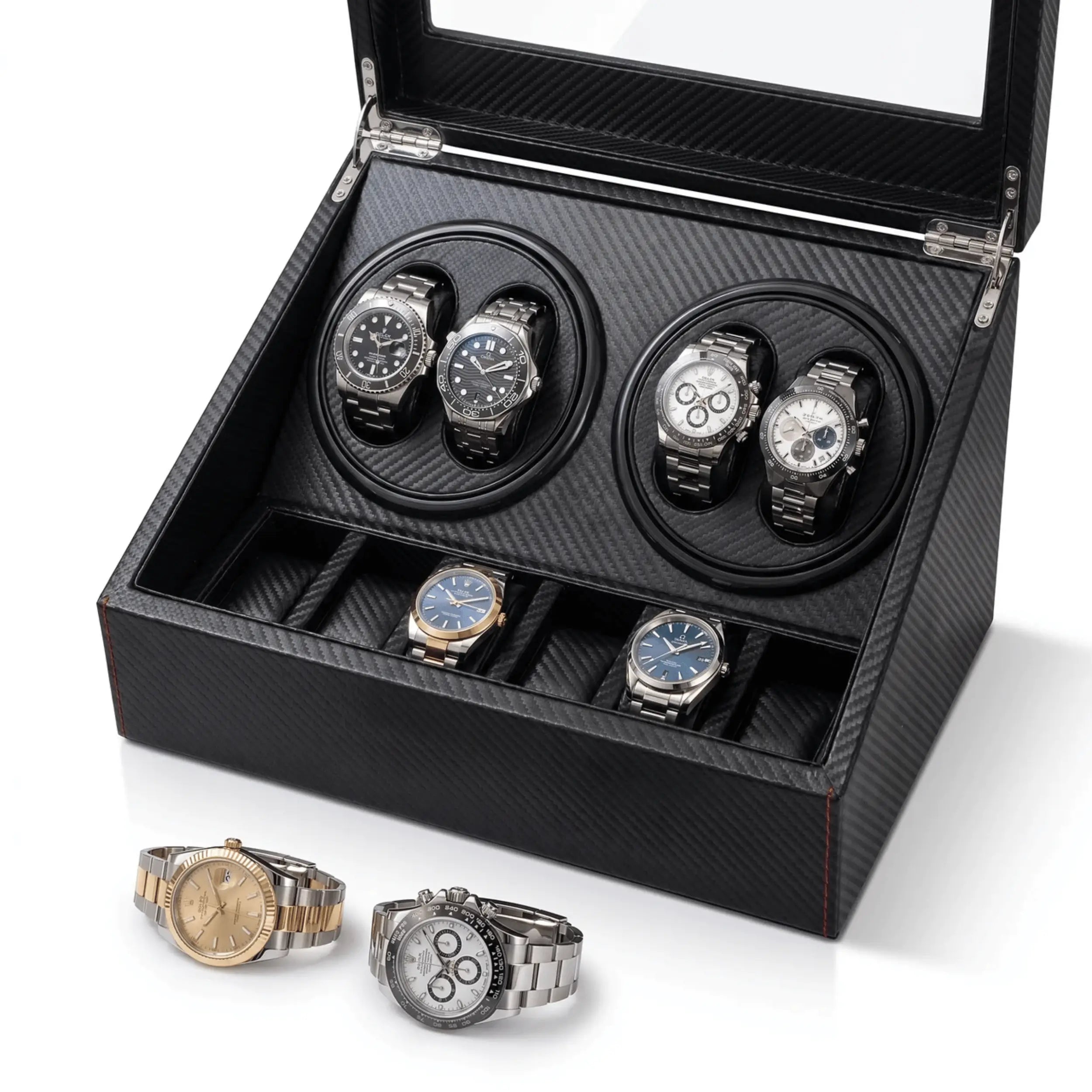
If the Daytona shares a winder with other watches, a multi-module model with independent programming is essential. Each slot is configured separately: 650 BOTH for the Daytona and Submariner, 800 BOTH if a Sky-Dweller reference 326xxx is present.
For a Collection with Integrated Protection
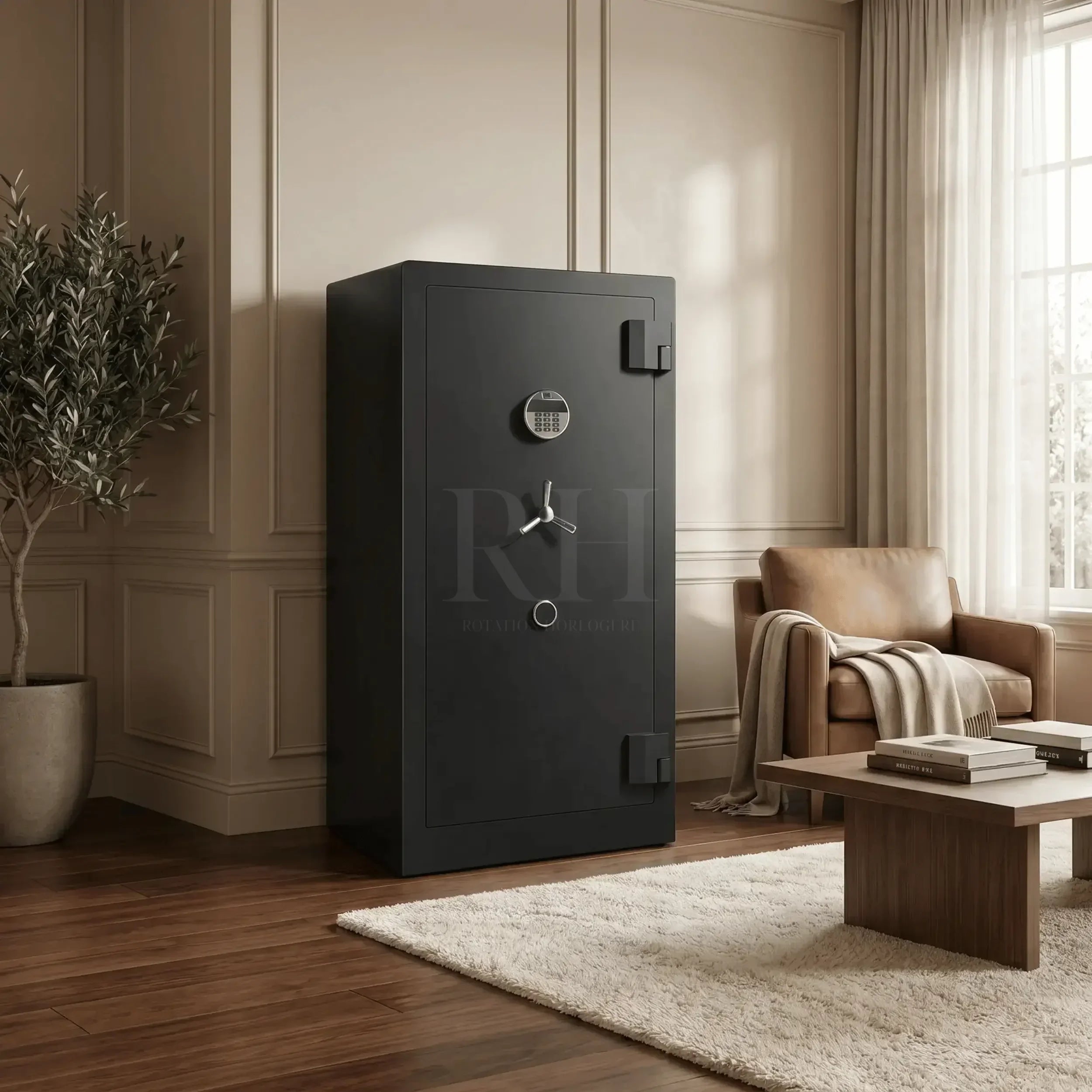
The value of a Daytona justifies the investment in a winder with biometric security. The Biometric President combines precision winding and fingerprint locking — for collections where security is as important as precision.

To remember. For a Daytona — all references included — the optimal setting is 650 TPD in BOTH mode. No Daytona equipped with Calibre 4130 requires a TPD higher than 650. A winder with adjustable TPD will allow you to keep the Daytona alongside all other Rolex watches in your collection without compromise.
Common Errors with the Daytona on a Winder
- Setting to 800 or 1000 TPD "for safety." Unnecessary. The 4130's slipping bridle mechanism absorbs the excess, but a chronically high TPD puts more strain on the winder motor and disengagement components. 650 is the exact value.
- Using a fixed CW mode on a shared winder. If the winder also accommodates bidirectional watches, a global CW mode halves the winding efficiency of these other watches.
- Placing the Daytona on an undocumented fixed TPD winder. For a watch worth €15,000–30,000, an adjustable TPD winder is a proportionate investment.
FAQ
What TPD for a Rolex Daytona Calibre 4130?
650 turns per day in bidirectional (BOTH) mode. This setting applies to all modern Daytona references equipped with Calibre 4130, whether steel versions (116500LN, 126500LN), gold (116508, 126508), or platinum (116506, 126506).
Should the Daytona be set to clockwise (CW) rather than bidirectional?
Rolex does not publish any official CW recommendations for the Daytona. All technical databases classify the Calibre 4130 as BOTH 650 TPD. The CW debate exists in the watch community but remains undocumented officially. BOTH 650 TPD is the risk-free setting compliant with available data.
Can a Daytona be placed on the same winder as a Submariner or a GMT-Master?
Yes, provided each slot is independently programmable. The Daytona, Submariner, and GMT-Master all share the same setting: 650 TPD BOTH. They can coexist on a multi-module winder without differentiated adjustment.
Can an excessively high TPD damage the Calibre 4130?
No. The slipping bridle mechanism integrated into the 4130 disengages the rotor from the mainspring when it is fully wound. Excessive TPD does not create overtension in the movement but unnecessarily stresses the winder motor in the long term.
How long does it take to wind a Daytona via a winder?
From a zero power reserve, allow 24 to 48 hours to reach full charge at 650 TPD. The Calibre 4130 has a 72-hour power reserve: a Daytona left unworn for 3 days will restart without manual intervention if placed on a winder from the first day of inactivity.
What is the difference in settings between the Daytona and the Sky-Dweller?
Sky-Dweller references 326xxx (old generation) require 800 TPD BOTH — the only notable exception in the current Rolex range. New references 336xxx return to 650 TPD BOTH, like the Daytona. If your collection mixes these two generations, a winder with independent modules is essential.
Which winder for a platinum or jewelry edition Daytona?
The TPD setting does not change according to the case material: 650 BOTH for all Daytonas. However, the value of a platinum or gem-set Daytona further justifies the investment in a winder with biometric security.
Rotation Horlogère Watch Winders · TPD Guide by Manufacturer · Watch Winder for Rolex Submariner

Written by Bastien Jaffre
Fondateur de Rotation Horlogère, expert en remontage automatique et accessoires horlogers haut de gamme. Depuis plusieurs années, il accompagne les passionnés de montres dans le choix de leurs remontoirs et coffrets, avec une approche rigoureuse centrée sur la technique et la qualité.

Leave a comment
This site is protected by hCaptcha and the hCaptcha Privacy Policy and Terms of Service apply.