
Movement, Case and Finishing: The Anatomy of a Good Men's Watch
A watch is often judged by its dial, sometimes by its brand, and rarely by what it is truly made of. Yet that is where everything is decided: two watches with comparable designs can differ in price by a factor of ten, and the difference lies in the movement, the case and a host of details that a trained eye can identify in seconds. Piece by piece, here is what makes a good men's watch — and what you are really paying for at each price level.
The movement: quartz, mechanical and automatic
The movement is the heart of the watch and the first criterion used to classify it. Quartz, powered by a battery, offers unbeatable accuracy — only a few seconds of deviation per month — at a low production cost and with virtually no maintenance. It is the rational choice and the one used by the vast majority of fashion watches. Hand-wound mechanical and automatic movements, wound by the motion of the wrist, follow a different logic: they are less accurate (by a few seconds per day) and more demanding to maintain, but they are alive — a mechanism made of dozens of parts beating at 28,800 vibrations per hour. You do not buy an automatic watch simply to tell the time; you buy it for what it represents.
A useful benchmark: a reliable Japanese quartz movement from Miyota or Seiko can confidently power watches priced from €80 to €300. Below that price for a working chronograph complication, be cautious; above €500 for a simple three-hand quartz watch, you are mainly paying for the name.
The case: material, machining and proportions
316L stainless steel is the serious standard: hypoallergenic and corrosion-resistant, it ages well and can be polished. Chrome-plated brass, common at entry level, flakes over time. Titanium, which is lighter and harder, remains uncommon below €400. Beyond the material, examine the machining: evenly polished sides, symmetrical lugs and a crown that screws down or clicks into place without play. Proportions matter too: a diameter of 40 to 42 mm suits most men's wrists, 38–39 mm works well for slimmer wrists, while anything above 44 mm enters statement-watch territory.

The crystal: sapphire, mineral and acrylic
The crystal is a reliable indicator of quality. Acrylic (Plexiglas) scratches at the slightest contact but is easy to polish — acceptable on vintage reissues. Mineral glass, standard on fashion watches, offers reasonable resistance to everyday scratches. Sapphire, which is almost impossible to scratch, is used in serious watchmaking; finding it below €300 is always an excellent surprise. An anti-reflective coating adds a level of readability that you only notice when it is missing.
Dial and finishing: where the eye is unforgiving
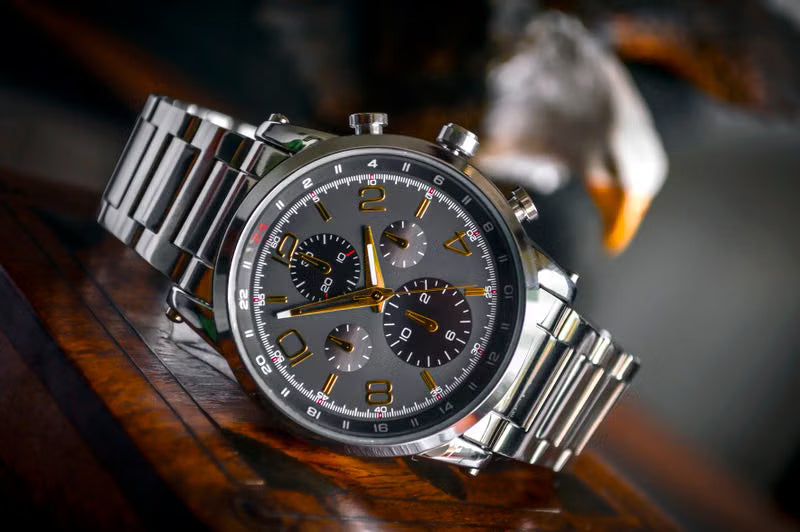
Use a loupe, or simply take your time: are the hour markers perfectly aligned? Do the faceted hands catch the light? Is the date window bevelled or roughly cut? The quality of a dial cannot be fully described on a product page; it has to be seen. This is precisely what separates well-made fashion watches — and there are many — from those that rely on a logo alone. Major fashion brands outsource production to manufacturers that also work for traditional watchmakers: the expertise is genuine; only the positioning is different.
Water resistance: reading between the lines
Water-resistance ratings can be misleading: 3 ATM (30 m) protects against rain, not a shower; 5 ATM tolerates occasional swimming; 10 ATM is suitable for regular swimming; diving begins at 20 ATM with a screw-down crown. These figures assume that the seals are new — they dry out over time, and a watch worn every day should have its water resistance checked every two or three years.

What you are really paying for at each price level
Below €100, you can find honest, unpretentious steel quartz watches. Between €100 and €400 — the core market for fashion brands — quality varies enormously from one model to another, and this is where the criteria above make the difference. At this level, choosing the right men's watch is mainly a matter of judging the finishing-to-price ratio; end-of-line models and official clearance sales can deliver the quality of the segment above at the price of the segment below. Above €500, serious Swiss and Japanese mechanical movements begin to appear; beyond €2,000, you enter manufacture watchmaking, where value shifts from the object itself toward heritage.
What matters on the wrist
A good men's watch is not necessarily expensive: it is a coherent watch in which every component matches its price. A reliable movement, 316L steel, a crystal suited to its use, clean finishing and honest water resistance — the checklist has five points, and it applies equally to a €90 watch and a €9,000 timepiece. In watchmaking, the only real mistake is paying for a component that is not there.

Written by Bastien Jaffré
Founder of Rotation Horlogère, expert in automatic winding and high-end watch accessories. For several years, he has supported watch enthusiasts in the choice of their watch winders and boxes, with a rigorous approach focused on technique and quality.

Leave a comment
This site is protected by hCaptcha and the hCaptcha Privacy Policy and Terms of Service apply.