

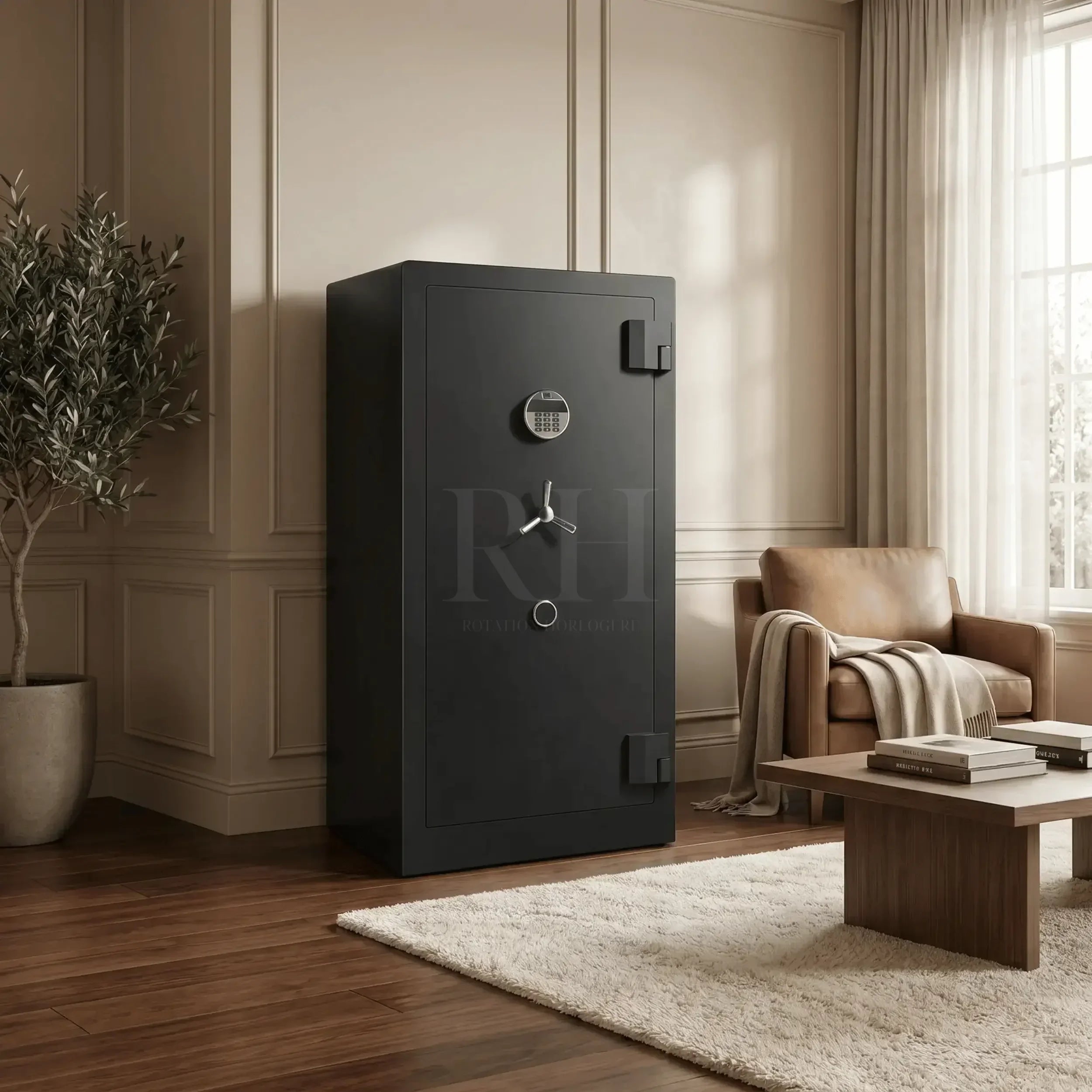
Watch Winder Safe: The Complete Collector's Guide (2026)
You own one or more valuable automatic watches. Each one represents years of savings, a memory, an emotion. Sooner or later, the question of protecting them becomes unavoidable — and with it, a choice most collectors make only once: an ordinary safe, or a watch winder safe?
The difference is fundamental. A standard safe keeps your timepieces away from burglars and fire. A watch winder safe does that and keeps your automatics wound, set to the correct time, and ready to wear at any moment — without you lifting a finger.
This guide explains how to choose the right model, what budget to expect, and why this piece of equipment is probably the most rational investment a serious collector can make.
What is a watch winder safe?

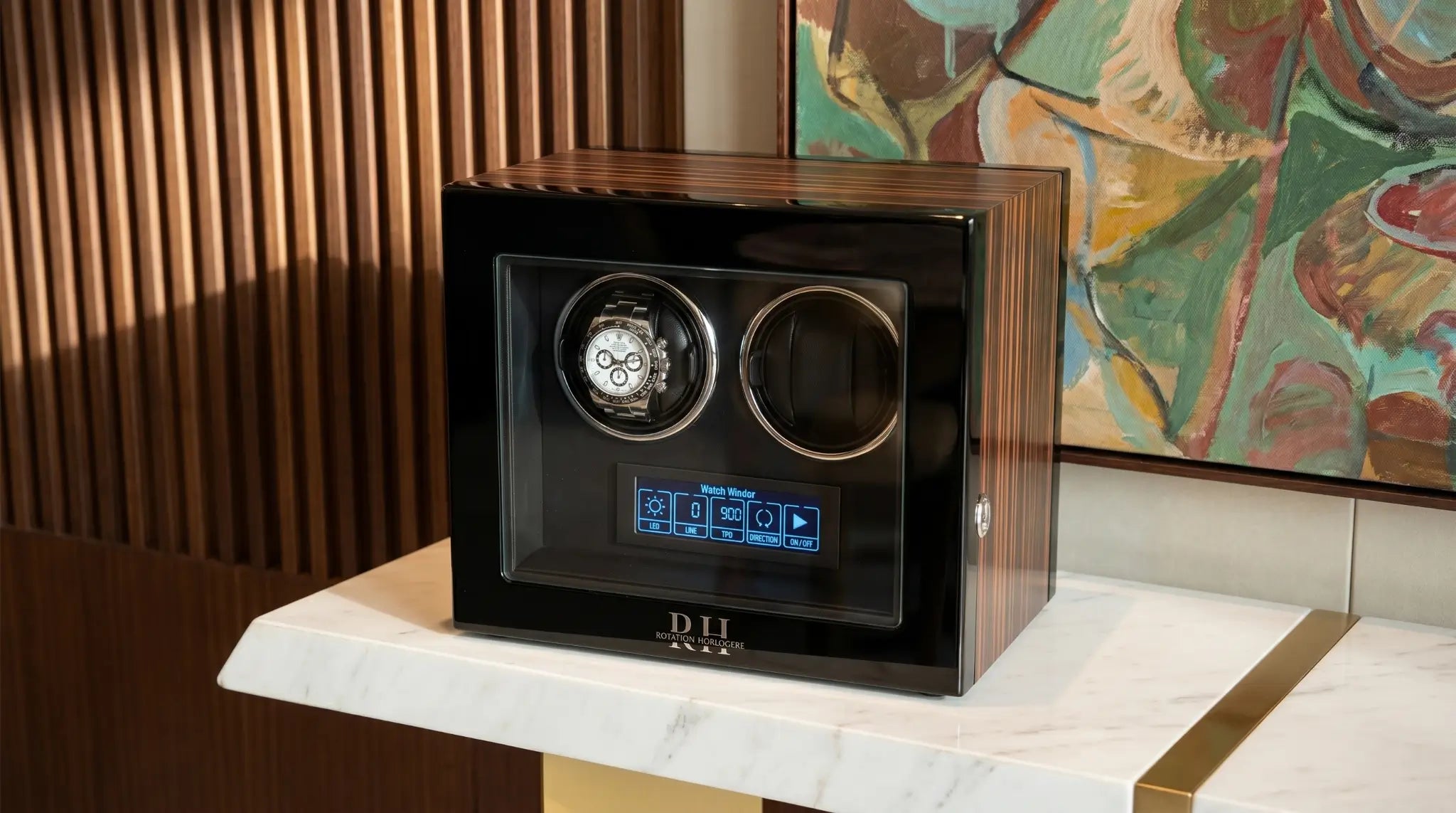
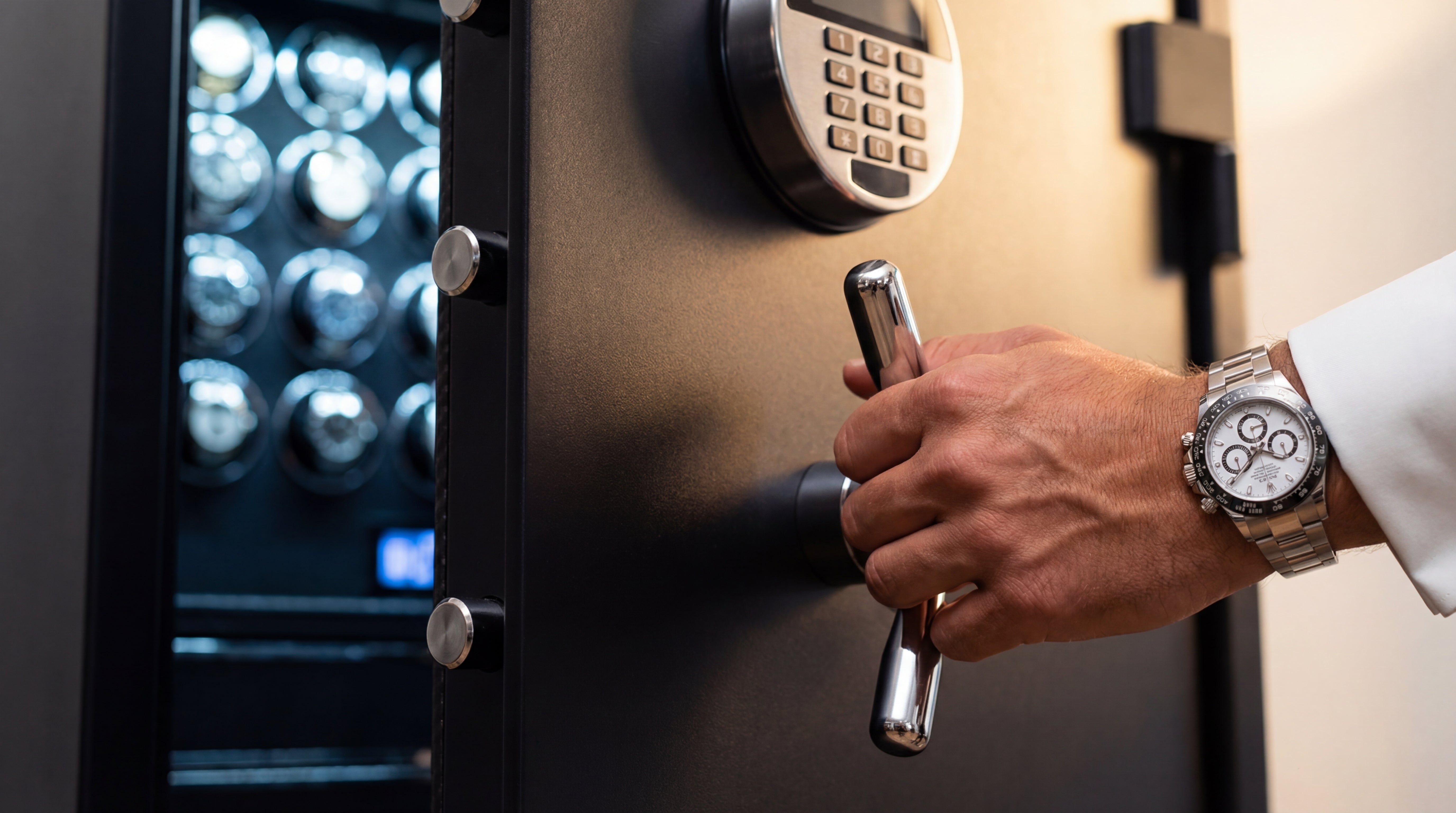
A watch winder safe is a hybrid piece of equipment combining two complementary functions: the security of a certified safe and the continuous maintenance of an integrated watch winder.
On the safe side, you get burglary resistance (sometimes fire protection), a secure locking mechanism, and a steel body that deters even equipped intruders. On the winder side, motorised rotors reproduce the natural movement of your wrist, keeping the mainspring of your automatic watches permanently wound.
Unlike a desktop or display winder, this type of equipment makes no compromise between security and maintenance. Your Rolex Submariner, your Patek Philippe Annual Calendar, or your IWC Portugieser Chronograph remains stored in optimal conditions around the clock, protected from prying eyes and uninvited hands.
Capacity varies by model: from 3 to 4 watches in compact versions up to 20, 30 or more in prestige models from Buben & Zorweg, Döttling, or Stockinger.
What is the best watch winder safe? The criteria that actually matter
Burglary resistance — the number one criterion
The first criterion for a quality watch winder safe is its resistance certification. In Europe, the benchmark standard is EN 1143-1, broken down into resistance classes (0 to VI). The higher the class, the longer the time required for trained testers to break in.
For a private collector, here is what each class means in practice:
- Class 0: basic resistance against unaided break-in attempts. Suitable for a collection worth less than €30,000.
- Class I: resistance to common tools (drill, light angle grinder). The minimum required by most insurers to cover declared valuables. Recommended for collections between €30,000 and €100,000.
- Class II: resistance to powerful, sustained tool attacks. The standard for serious collectors and professionals. For collections between €100,000 and €300,000.
- Class III: resistance to very powerful tools with prolonged attack. Required by some insurers for collections above €300,000.
- Class IV: enhanced resistance including explosive testing in addition to tools. This is the entry point for institutional use — private banks, high-value goods dealers, jewellers.
- Class V: used in financial institutions and high-value transport. Not applicable for residential use.
- Class VI: the highest level under the standard, reserved for banking infrastructure and high-security vaults.
In practice, Classes IV to VI are not found in private homes — their weight alone (several tonnes) makes domestic installation impossible.
Most home insurers require EN 1143-1 certification to cover valuables stored at home. Always check your policy conditions before purchasing.
The quality of the integrated watch winder
This is where many low-cost watch safes disappoint. A poorly calibrated winder can over-wind a movement and damage the mainspring over time. The parameters to check before any purchase:
Turns per day (TPD): every automatic movement has a recommended TPD range. A Rolex calibre 3135 requires approximately 650 TPD bidirectionally; an ETA 2824 runs well between 650 and 800 TPD. A Patek Philippe calibre 315 SC needs only 300. A quality watch winder safe allows you to set the TPD per individual winding slot.
Rotation direction: CW (clockwise), CCW (counterclockwise), or BOTH (bidirectional). The vast majority of modern movements accept bidirectional rotation — but some vintage or specialist movements only accept one direction. Always verify your calibre's requirements before choosing a winder.
Individual programming: high-end models allow you to configure TPD and direction for each slot independently. Essential if you mix movements with very different requirements.
Noise level: a watch safe in a home office or bedroom must run quietly. This point is often underestimated at the point of purchase — pay close attention to user reviews on this specific criterion.
Capacity: think about your future collection
A collector with 4 watches today will often have 8 or 10 within three years. Modular models allow the interior to be reconfigured at low cost. It is always better to buy slightly too large than to run out of space six months after purchase.
Practical benchmarks:
- 1 to 4 watches: compact safe, desk or dressing room format
- 5 to 12 watches: mid-range, cabinet or recessed format
- 12 to 30 watches: premium range, freestanding or floor-anchored safe
What are the disadvantages of a digital watch safe?
Electronic locks are now widespread on watch winder safes, and their advantages are obvious: code-based access with nothing to lose, easy code changes, and on some models, tamper alerts.
But their disadvantages are worth knowing before you buy.
Battery dependency. An electronic lock with dead batteries is a locked safe. Serious models signal battery depletion well in advance and include a physical key override. Avoid any safe without this dual access.
Vulnerability on uncertified models. A budget digital safe can be bypassed by direct solenoid manipulation or electronic glitching — techniques well known to professional burglars. This risk disappears on VdS 2 or EN 1143-1 Class I certifications and above, but it is real on entry-level models.
Forgotten codes. A forgotten code typically requires a certified locksmith — often at significant cost. Always store your master code securely in a location separate from the safe itself.
A mechanical combination lock remains the most robust long-term solution: no batteries, no software vulnerabilities, no electrical dependency. It is simply slower to operate on a daily basis.
How much does a quality watch winder safe cost?
The price range is wide, reflecting very different realities in terms of burglary protection and winder quality.
Entry-level secured winder: €200 – €1,500
Lockable boxes with an integrated winder. Thin walls, basic protection against unauthorised access. Suitable for getting started with 1 to 3 watches of modest value.
Mid-range watch winder safe: €1,500 – €6,000
Programmable bidirectional winder, reinforced walls, serious resistance to opportunistic break-ins. The right entry point for genuine protection for a collection of 3 to 8 watches.
Premium watch winder safe: €8,000 – €18,000
Thick steel construction, high-quality winder with individual slot programming, refined finishes. The range sized for collectors with 5 to 20 watches requiring serious protection.
Ultra-prestige: above €100,000
The major European houses — Buben & Zorweg, Döttling, Stockinger — create watch winder safes that are also exceptional furniture pieces: selected woodwork, scenic lighting, total customisation. Objects with intrinsic value in their own right.
Is a watch winder safe a good investment?
From an insurance perspective: most home contents policies cap coverage on valuables without specific protection in place. An EN 1143-1 certified safe allows you to declare your collection at its true value and be covered in the event of theft or fire. Over five years, the difference in premium can offset a significant portion of the safe's cost.
From a maintenance perspective: an automatic movement left stationary for extended periods will eventually see its lubricating oils congeal. A quality winder avoids premature servicing — which typically costs €300 to €800 per watch at an independent watchmaker, and up to €2,000 at the manufacturer for complex movements.
From a peace of mind perspective: impossible to quantify, but real. Knowing your collection is wound, secured, and ready to wear is a form of comfort that serious collectors consistently describe as an obvious decision in hindsight.
How to choose the right watch winder safe for your situation
1 to 3 watches, total value under €5,000 → Focus on winder quality. A compact safe with adjustable TPD is sufficient. Budget: €300 to €800.
3 to 8 watches, total value €5,000 – €20,000 → VdS 1 certification minimum, bidirectional winder with per-slot programming. Budget: €800 to €2,500.
8 watches or more, value above €20,000 → EN 1143-1 Class I or II certification, wall or floor anchoring, quality lock mechanism. Budget: €2,500 to €10,000.
Prestige collection above €50,000 → Class II or III, installation by a certified professional, declaration to your insurer is essential. Also consider placement carefully — read our guide on where to install your watch winder safe.
Conclusion
A watch winder safe is not reserved for the ultra-wealthy — it is a piece of equipment that justifies itself the moment your collection represents meaningful economic or sentimental value. Choose it based on your current and future collection, the movements you own (TPD and rotation direction), and the space available in your home.
The combination of protection and maintenance it provides has no equivalent. For a passionate automatic watch collector, it is exactly that: the piece of equipment that closes the loop.
→ Browse our selection of watch winder safes
→ Read also: Digital watch safe vs mechanical lock — honest comparison

Written by Bastien Jaffre
Fondateur de Rotation Horlogère, expert en remontage automatique et accessoires horlogers haut de gamme. Depuis plusieurs années, il accompagne les passionnés de montres dans le choix de leurs remontoirs et coffrets, avec une approche rigoureuse centrée sur la technique et la qualité.

Leave a comment
This site is protected by hCaptcha and the hCaptcha Privacy Policy and Terms of Service apply.