


Wood, leather or carbon watch winder: which one to choose for your collection?
The choice of material for a watch winder is often presented as a purely aesthetic matter. This is a mistake. The case material directly influences acoustic performance, durability, vibration absorption, and integration into your living space. This guide objectively compares the three main families of materials — wood, leather, and carbon — to help you make the right choice according to your use and your watches.
Wood: Tradition, Warmth, and Natural Vibration Absorption
Technical advantages
Solid wood is the historical material for prestige watch winders, and not just for aesthetic reasons. Its fibrous structure naturally absorbs micro-vibrations generated by the motor, which directly contributes to silent operation. A quality solid wood winder — ebony, walnut, pearwood — will be structurally quieter than a plastic or MDF winder with the same motorization.
Wood also slightly regulates ambient humidity, creating a stable microclimate inside the case — a marginal but real advantage for long-term watch preservation.
Disadvantages
Wood is sensitive to variations in humidity and temperature. A solid wood winder placed near a heat source or in a very dry room can deform slightly over time. It requires minimal maintenance — a lightly oiled cloth once or twice a year is enough to preserve the wood's luster and prevent drying out.
Wood is also heavier than carbon, which can be a factor depending on the intended location for your winder.
Who is it for?
Wood is perfect for classic watch enthusiasts who want a winder that blends into a warm interior — a library, a dark wood office, a masculine dressing room. It is the material of grand watchmaking houses and heritage collections.


Leather: Refinement, Exclusivity, and Visual Presence
Technical advantages
Leather brings a tactile and sensory dimension that neither wood nor carbon can reproduce. A winder clad in genuine leather — ostrich leather, checkered leather, grained leather — is primarily a luxury piece of furniture as much as a horological device. The combination with a black piano lacquer creates a strong visual contrast, immediately identifiable as a collector's item.
Technically, leather also dampens vibrations of contact between the case and its resting surface. It is more flexible than wood and adapts better to slight environmental variations.
Disadvantages
Leather is the most demanding material in terms of maintenance. Exposed to prolonged direct light, it can dull or discolor. Excessive humidity can cause stains or softening of the structure. A leather winder must be placed away from direct light and in a humidity-controlled environment.
Exotic leather — ostrich, lizard, crocodile — is also the most expensive of the three materials, which is reflected in the pricing of winders that use it.
Who is it for?
Leather is the choice of collectors who consider their winder to be an art object as much as a horological tool. It is perfect for display in a showcase, in a living room, or a representative office, where the winder is as visible as the watches it contains.
Carbon: Performance, Modernity, and Lightness
Technical advantages
Carbon fiber is the most performing of the three materials from a purely technical standpoint. Its structural rigidity is superior to that of wood and leather — vibrations are less transmitted through the structure, and the case does not deform over time regardless of ambient humidity or temperature.
Carbon is also the lightest of the three materials for an equivalent volume, which makes it easy to move and reposition. Its scratch resistance is excellent — a carbon winder retains its new appearance much longer than a lacquered wood winder subjected to daily bumps.
Aesthetically, the characteristic weave of carbon fiber evokes the world of sports watchmaking and high performance — Rolex Daytona, Richard Mille, Audemars Piguet Royal Oak Offshore. It is a visual language immediately recognizable by enthusiasts of sports and mechanical watches.
Disadvantages
Carbon is cold — literally and figuratively. A carbon winder in a classic or traditional interior may seem out of place. It is a material that belongs to a precise aesthetic universe: contemporary, technical, masculine. If your interior is warmer, wood or leather will integrate better.
Who is it for?
Carbon is suitable for collectors of sports watches — Daytona, Submariner, Royal Oak, Nautilus — who want aesthetic coherence between their watches and their winder. It is also the natural choice for a modern office or a minimalist space.
Synthetic Comparison
| Criterion | Wood | Leather | Carbon |
|---|---|---|---|
| Vibration Absorption | Excellent | Good | Excellent |
| Operating Silence | Very Good | Good | Very Good |
| Durability | Good | Average | Excellent |
| Maintenance | Minimal | Regular | None |
| Classic Interior Integration | Excellent | Excellent | Average |
| Modern Interior Integration | Good | Good | Excellent |
| Visual Prestige | High | Very High | High |
| Humidity/Temperature Resistance | Average | Low | Excellent |
What about black piano lacquer?
Black piano lacquer deserves a separate mention. It is not a material in itself — it is a finish applied to wood or MDF that gives it an ultra-glossy mirror-like appearance. It is the most common finish in the mid-range of quality watch winders, and for good reasons: it is elegant, neutral, and fits into any interior.
Its main drawback is its sensitivity to fingerprints and micro-scratches. A black piano lacquered winder requires regular cleaning with a microfiber cloth to maintain its shine. Avoid contact with abrasive products.
Our Winders by Material
Solid Wood. The Ambassadeur Pearwood Floral and the Ambassadeur Ebony represent the pinnacle of wood finish in our catalog — selected solid wood, unique natural grain, available in 2 to 12 slots.
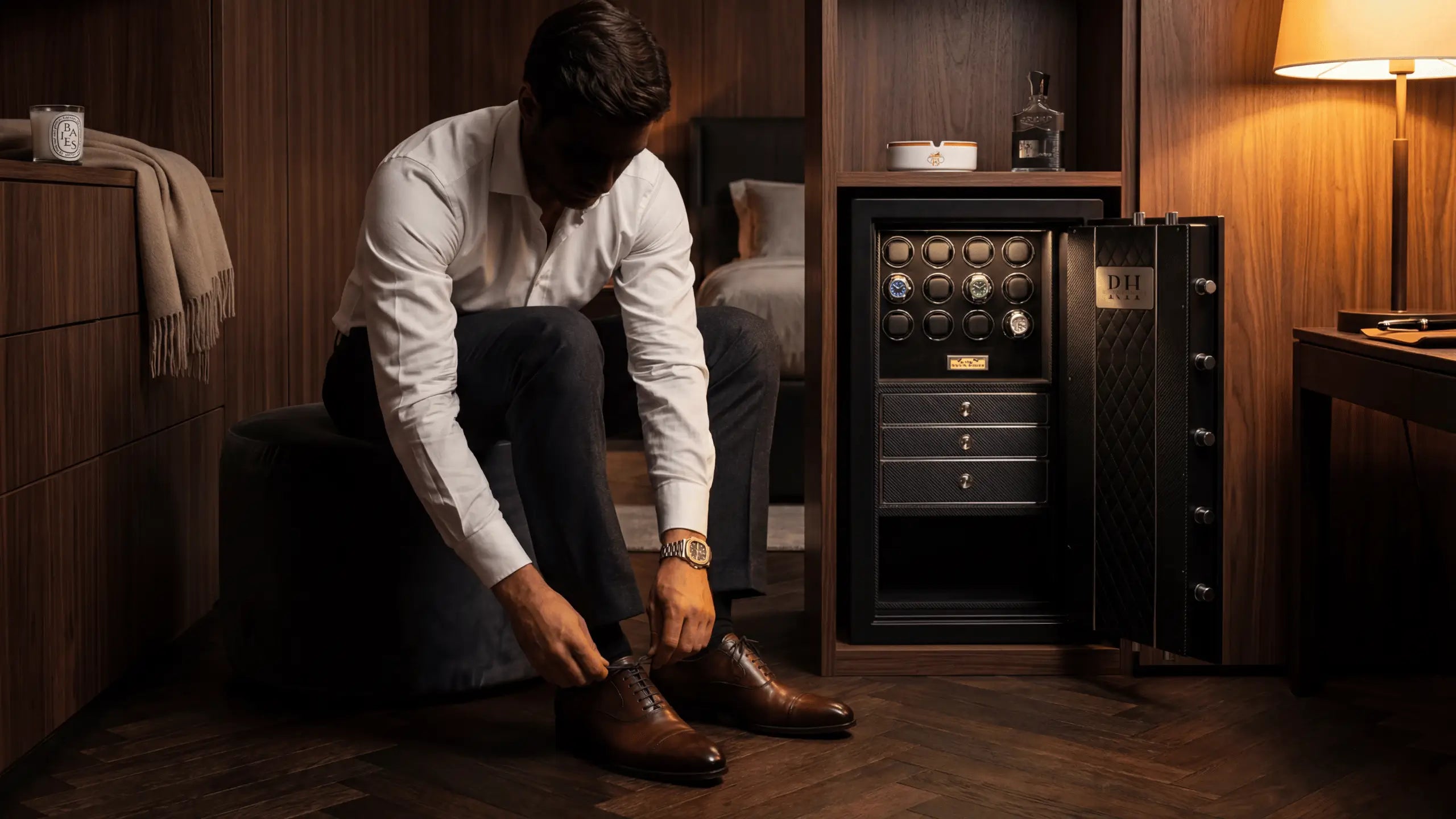
Leather. The Bellagio Pro™ and the Bellagio Max™ are available in a checkered leather finish — an exclusivity that combines the robustness of a safe with the refinement of luxury leather.
Carbon. The Quantum Carbon (1 to 6 slots) and Carbon Elite ranges offer the technical performance of carbon fiber in a compact and contemporary format.

Discover our entire collection of automatic watch winders, or our safe winders available in wood, leather, and carbon finishes.
This article is part of our series of technical guides on the care and storage of automatic watches.

Written by Bastien Jaffre
Fondateur de Rotation Horlogère, expert en remontage automatique et accessoires horlogers haut de gamme. Depuis plusieurs années, il accompagne les passionnés de montres dans le choix de leurs remontoirs et coffrets, avec une approche rigoureuse centrée sur la technique et la qualité.


Leave a comment
This site is protected by hCaptcha and the hCaptcha Privacy Policy and Terms of Service apply.