

Watch winder for watches with a long power reserve: what you need to know
Watches with a long power reserve — Panerai, IWC Portugieser, some Jaeger-LeCoultre, Patek Philippe — are exceptional pieces. Their oversized mainspring allows them to run for several days, or even a full week, without being worn. But this characteristic fundamentally changes how they interact with a watch winder. A standard setting designed for a Rolex or an Omega is not necessarily suitable for these particular calibers.
This guide explains why, and how to configure your winder to preserve these exceptional watches.
Why watches with a long power reserve are different
A standard automatic watch — Rolex, Omega, Tag Heuer — has a power reserve of 38 to 55 hours. Its mainspring charges and discharges relatively quickly. A winder set to 800 TPD bidirectional keeps this type of watch fully charged without difficulty.
A watch with a long power reserve works differently. Its mainspring is physically longer, thicker, or features a special energy storage mechanism. It takes more time to fully charge — but once charged, it lasts much longer.
Direct consequence for the winder: these watches need fewer TPD to stay charged, not more. An overly active winder unnecessarily stresses the clutch mechanism continuously, which generates premature wear in the long run.
The most common long power reserves
| Watch | Power Reserve | Recommended TPD | Rotation Direction |
|---|---|---|---|
| Panerai Luminor Base | 72 hours | 500–650 | Bidirectional |
| Panerai Luminor Marina | 72 hours | 500–650 | Bidirectional |
| IWC Portugieser (cal. 52010) | 7 days | 500–600 | Bidirectional |
| IWC Big Pilot (cal. 51111) | 7 days | 500–600 | Bidirectional |
| Jaeger-LeCoultre Master Ultra Thin | 70 hours | 600–750 | Bidirectional |
| Jaeger-LeCoultre Geophysic | 38 hours | 650–800 | Bidirectional |
| Patek Philippe (cal. 240) | 48 hours | 650–750 | Bidirectional |
| Patek Philippe (cal. 324) | 45 hours | 650–800 | Bidirectional |
| A. Lange & Söhne Lange 1 | 72 hours | 500–650 | Bidirectional |
| Breguet Classique (cal. 777Q) | 60 hours | 600–750 | Bidirectional |
| Universal conservative setting | — | 650 | Bidirectional |
The problem of continuous overwinding
A watch with a 7-day power reserve placed on a winder set to 900 TPD will be fully charged in a few hours. The clutch mechanism then takes over — and remains continuously stressed for the remaining 6 days and 22 hours, 24 hours a day.
This is not catastrophic in the short term. But over several years of permanent use, this continuous stress on the safety click accelerates its wear. It's the equivalent of letting a car engine run continuously at idle — it doesn't break immediately, but it causes premature wear.
The solution: reduce to 500–650 TPD for these watches. The spring will charge more slowly, the clutch mechanism will be less stressed, and your watch will last longer between revisions.
How to identify the correct setting for your watch
The most reliable method is the power reserve test:
Step 1 — Set your winder to 650 TPD bidirectional and let your watch run for 48 hours.
Step 2 — Remove the watch from the winder and set it down without wearing it. Note the exact time.
Step 3 — Check how long it runs before stopping. It should run for at least 90% of its theoretical power reserve — about 65 hours for a 72h Panerai, or 6 days for a 7-day IWC.
Step 4 — If it stops earlier, gradually increase in increments of 50 TPD until you achieve the desired result. If it runs without issue, you can even go down to 500 TPD to further reduce stress on the mechanism.


Do you need a dedicated winder for each watch?
Not necessarily — but your winder must allow independent TPD adjustment per slot. If you place an IWC Portugieser (500 TPD) next to a Rolex Submariner (800 TPD) on the same winder, both positions must be able to rotate at different speeds.
A winder with a single global setting — a single TPD value for all slots — is incompatible with a mixed collection including long power reserve watches. You would be forced to choose: either you underwind the Rolex, or you over-stress the IWC.
The rule is simple: one slot, one setting.
Complication watches and their interaction with the winder
Grand complication watches — tourbillon, perpetual calendar, minute repeater — deserve special attention. These calibers consume more energy than simple watches, but their winding mechanism remains identical.
For these watches, the main risk is not overwinding but underwinding. A perpetual calendar watch that runs out of power can advance the date and day indications erratically, requiring a lengthy and delicate correction. Keep these watches at their optimal charge at all times — between 700 and 850 TPD depending on the caliber.
Watches with moon phase are particularly sensitive: a stop of a few hours is enough to shift the moon display, which only resets after precise adjustment to 1/29.5 of a day. On a properly configured winder, this problem simply does not exist.
Which winder for a long power reserve watch?
The absolute criterion: the TPD setting must go down to a minimum of 500 TPD, with fine increments for refinement according to your caliber. Many low-end winders start at 650 or 700 TPD — insufficient for a 7-day IWC or a Panerai.
The Héritage, Président, Chancelier and Ambassadeur ranges cover a setting range that goes down to the low values required for long power reserves, with individual programming per slot. Ideal if your collection mixes standard watches and long power reserve watches.


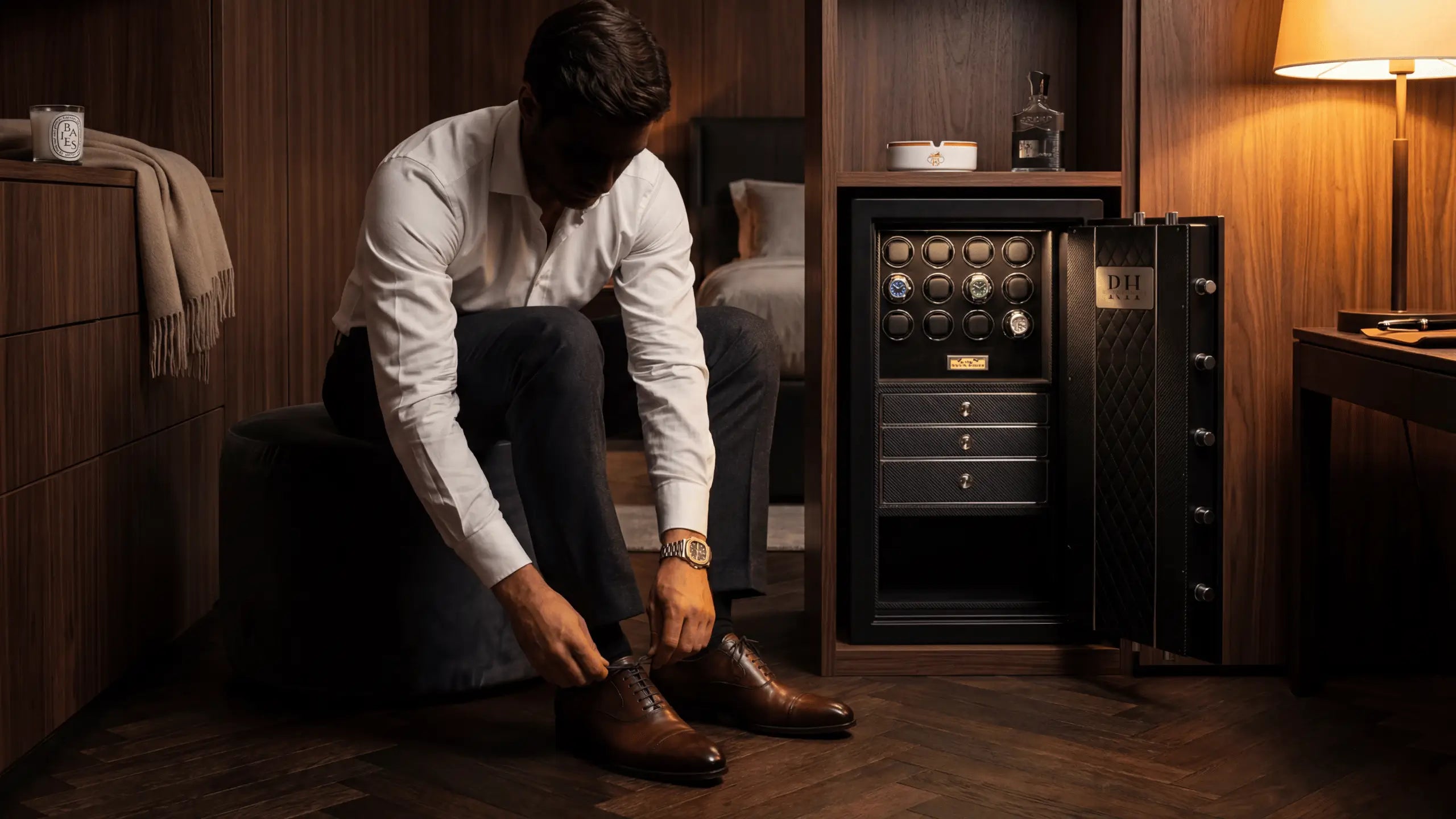
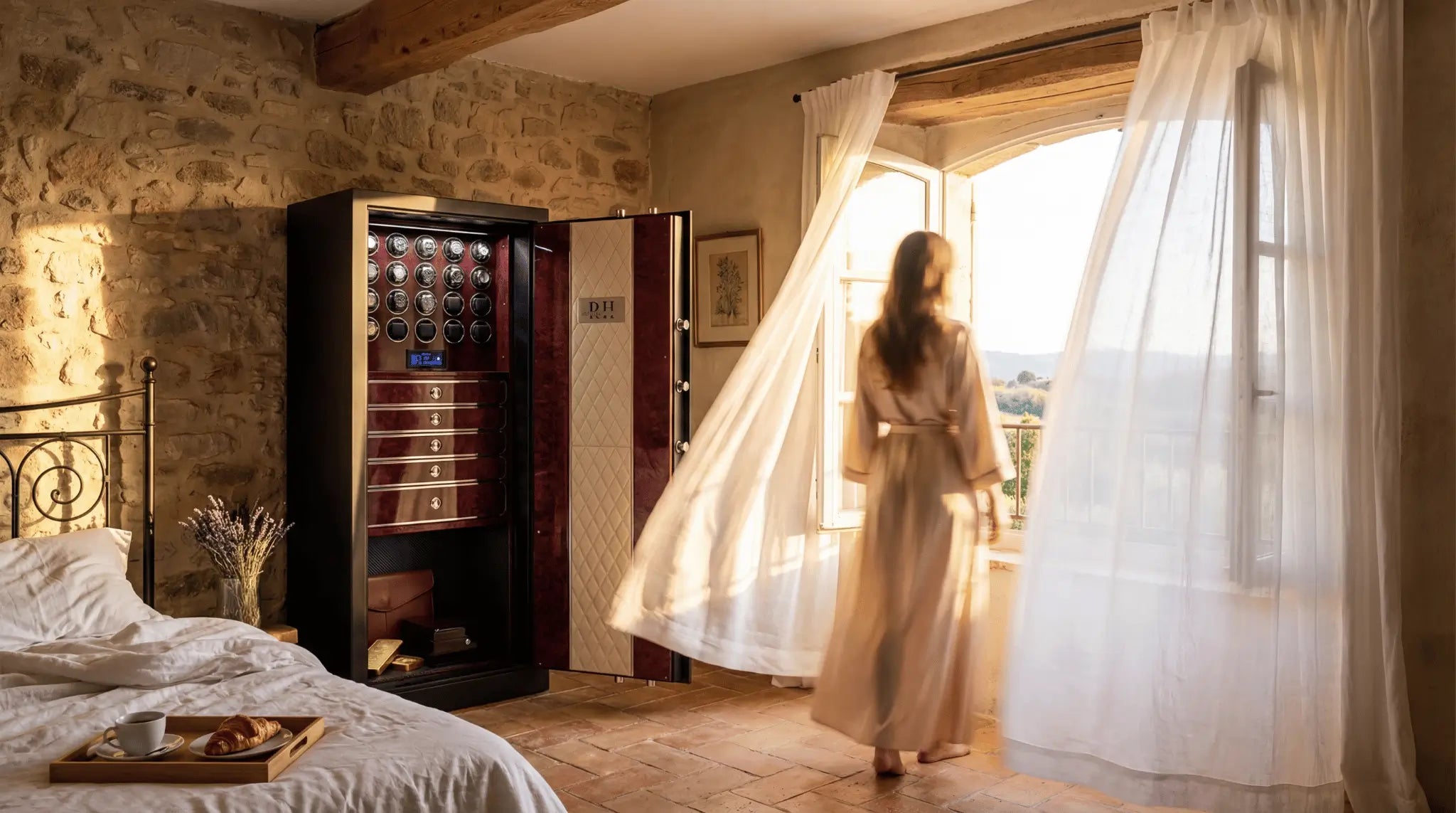
For collectors who want to combine precise winding and physical security, the Bellagio™, Bellagio Pro™ and Bellagio Max™ watch winder safes offer the same setting precision in an armored safe — physical and mechanical protection combined.
Consult our TPD guide by reference for exact values, or explore our complete collection of automatic watch winders.
This article is part of our series of technical guides on the maintenance and storage of automatic watches.

Written by Bastien Jaffre
Fondateur de Rotation Horlogère, expert en remontage automatique et accessoires horlogers haut de gamme. Depuis plusieurs années, il accompagne les passionnés de montres dans le choix de leurs remontoirs et coffrets, avec une approche rigoureuse centrée sur la technique et la qualité.


Leave a comment
This site is protected by hCaptcha and the hCaptcha Privacy Policy and Terms of Service apply.