


My Watch Winder is Too Loud: Causes, Solutions, and Silent Models
An automatic watch winder is, by nature, a discreet device. Its role is to keep your mechanical watches moving 24 hours a day, without ever drawing attention to itself. Yet, sometimes certain models emit noises that become difficult to ignore — especially when the winder is placed in a bedroom or a silent office.
If you find yourself looking for why your winder is making noise, you've come to the right place. This article deciphers the precise causes of this problem, the solutions to apply for each case, and the technical criteria to check before any purchase to avoid this inconvenience.
Causes of noise
Before considering a solution, it is necessary to identify the source of the noise. Not all noises are equivalent, and each corresponds to a distinct cause.
1. Poor quality motor
This is the most frequent cause in entry-level winders. A cheap DC motor generates mechanical vibrations that are transmitted to the casing structure. The result: a continuous hum, often noticeable several meters away.
Higher quality motors — especially Japanese constant-torque motors — operate below 10 decibels. For reference, a human whisper is around 30 dB. A well-designed winder should be almost inaudible in a quiet room.
2. Unsuitable mounting surface
A winder placed on a hollow or resonant surface — glass top, thin wooden shelf, floating board — can significantly amplify motor vibrations. What you hear is not the motor itself, but the surface acting as a sound box.
3. Incorrectly positioned watch cushion
The watch itself can be a source of noise if it is not properly held in its slot. A watch that oscillates, whose crown hits the cushion, or whose metal bracelet clatters against the back of the tray will generate parasitic noises with each rotation cycle.
4. Vibrating or detached casing
On multi-position winders, internal components — rotating trays, hinges, fastening screws — can loosen over time. A slight mechanical play is enough to create a rhythmic clicking, particularly audible during counter-clockwise rotation or when changing direction.
5. Interference between multiple winders
In a configuration with multiple winders side-by-side, vibrations can transmit from one device to another. The result is amplified resonance, whereas each winder, taken individually, would be perfectly silent.
Solutions for each cause
If the problem comes from the motor
The solution is direct: replace the winder with a model equipped with a higher quality motor. A Japanese constant-torque motor, properly insulated inside the case, goes below 10 dB in continuous operation. This is the threshold below which noise becomes imperceptible in almost all domestic environments.
Rotation Horlogère's Héritage, Président or Chancelier range winders integrate this type of motorization, making them suitable for use in a bedroom or dressing room.


If the problem comes from the mounting surface
Place a vibration-absorbing support between the winder and its receiving surface. A thick felt mat, a cork support, or simply a solid surface (stone, concrete, marble) will significantly reduce vibrational transmission. Avoid suspended shelves and hollow particle board furniture.
If the problem comes from the cushion
Check the fit of the watch in its slot. The watch wrist should be held firmly, without lateral play. If the cushion is too small for your case, it is often possible to replace it with a larger diameter cushion. Metal bracelets can be slipped into a leather or velvet protective sleeve to avoid direct contact with the tray walls.
If the problem comes from the casing
Inspect the fastening screws of the rotating trays and retighten them if necessary. On some models, compressed air cleaning of the contact areas between moving components can eliminate small particles that create parasitic friction. If the problem persists after these interventions, contact after-sales service — abnormal mechanical play is a defect covered by warranty.
If you have multiple winders side by side
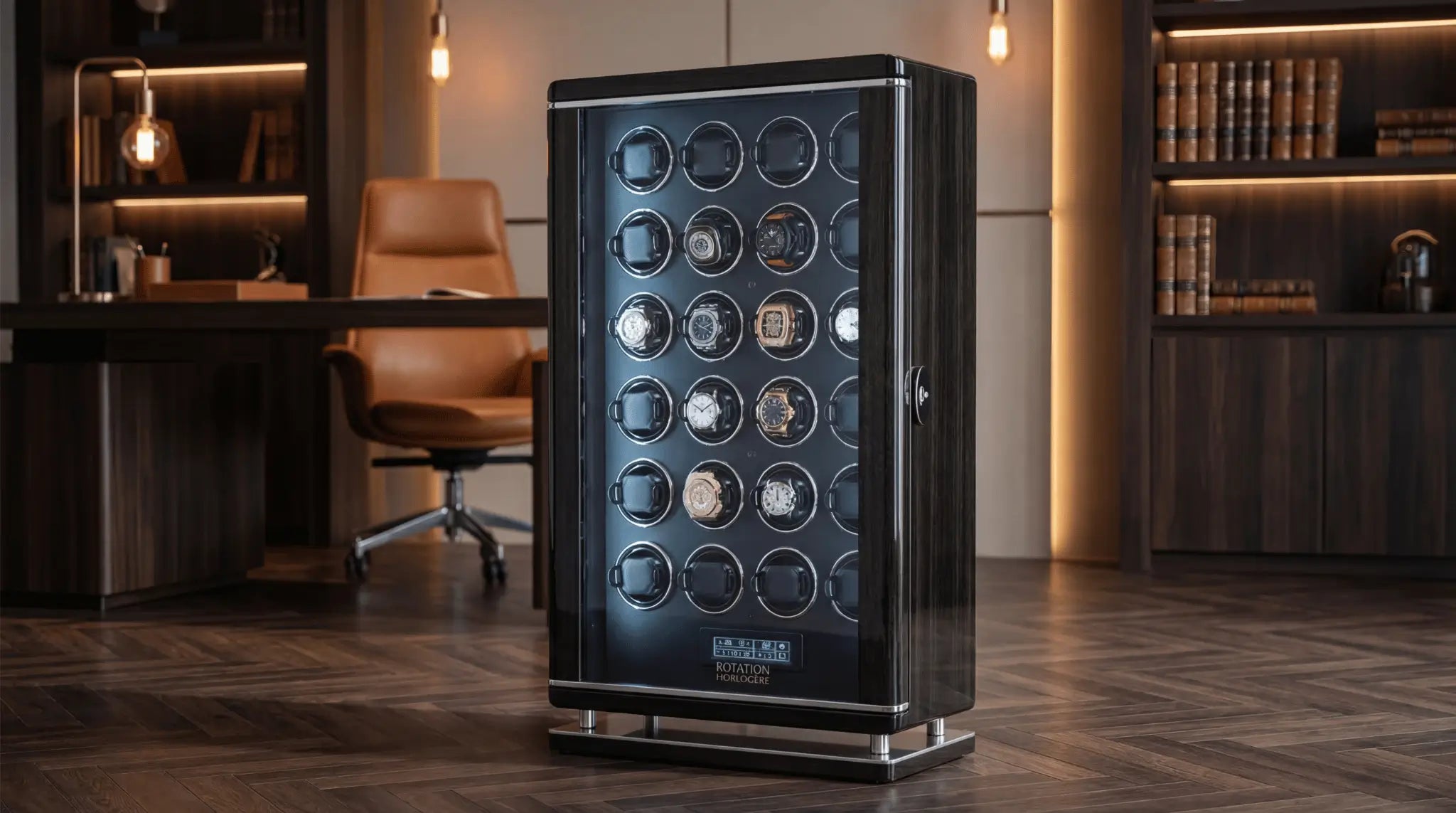
Space the devices at least 5 to 10 centimeters apart to avoid vibration transmission. Place a dense material plate between each winder. Alternatively, a multi-position winder like the Diplomat (24 watches) or the Quantum Carbone ranges (4 and 6 slots) group several watches in a single case — which structurally eliminates this problem.
How to choose a silent winder from the start
The noise of a winder is not always apparent when reading product descriptions. Here are the technical criteria that guarantee silent operation, regardless of the displayed price.
The motor's sound level. A silent winder must have a sound level below 10 dB. This data is not always explicitly communicated — its presence in the specifications is already a good indicator of the manufacturer's seriousness.
The type of motor. Japanese constant-torque motors are the benchmark in terms of silence and longevity. They maintain a stable rotation speed without jerks, which eliminates low-frequency vibrations.
Internal motor insulation. A well-designed case insulates the motor from the rest of the structure via anti-vibration gaskets. This insulation is particularly important for wooden or composite material winders, which are naturally more resonant than metal.
Electromagnetic shielding. Unshielded printed circuits can emit interference which, in some cases, generates audible noise. Winders compliant with IEC 60068-2-10 are protected against this type of interference.
The quality of the casing materials. A solid wood, carbon, or piano black lacquer case absorbs vibrations better than a plastic or MDF case. This is one reason why high-end winders are structurally quieter, regardless of motor quality.
Which silent winder to choose based on your use?
For 1 to 2 watches. The Héritage, Président and Chancelier ranges are available from 2 slots with silent motorization and individual adjustment per position.
For up to 12 watches. The same ranges go up to 12 slots. The Ambassadeur Ébène adds a solid ebony wood finish that naturally absorbs vibrations.
For a collection with security. The Bellagio™, Bellagio Pro™ and Bellagio Max™ winder safes integrate acoustic insulation into the very design of the safe — thick walls, sealing gaskets, rigid structure.
For absolute demand. The Vauban™: solid steel structure, total vibration insulation, guaranteed silence at full capacity.
What silence says about your winder
A silent winder is not a luxury. It is a sign that the motor is running at its nominal speed without excessive effort, that the components are correctly assembled, and that vibrations are controlled rather than ignored. Mechanically, a vibrating winder transmits these same stresses to your watch — which, in the long term, is not without consequences for the most delicate components of the movement.

Choosing a silent winder is also choosing a winder that truly protects what it is meant to preserve.
To explore our silent watch winders, consult our complete collection of automatic watch winders, or discover our winder safes for maximum protection of your most precious timepieces.
This article is part of our series of technical guides on the maintenance and storage of automatic watches.

Written by Bastien Jaffre
Fondateur de Rotation Horlogère, expert en remontage automatique et accessoires horlogers haut de gamme. Depuis plusieurs années, il accompagne les passionnés de montres dans le choix de leurs remontoirs et coffrets, avec une approche rigoureuse centrée sur la technique et la qualité.


Leave a comment
This site is protected by hCaptcha and the hCaptcha Privacy Policy and Terms of Service apply.