

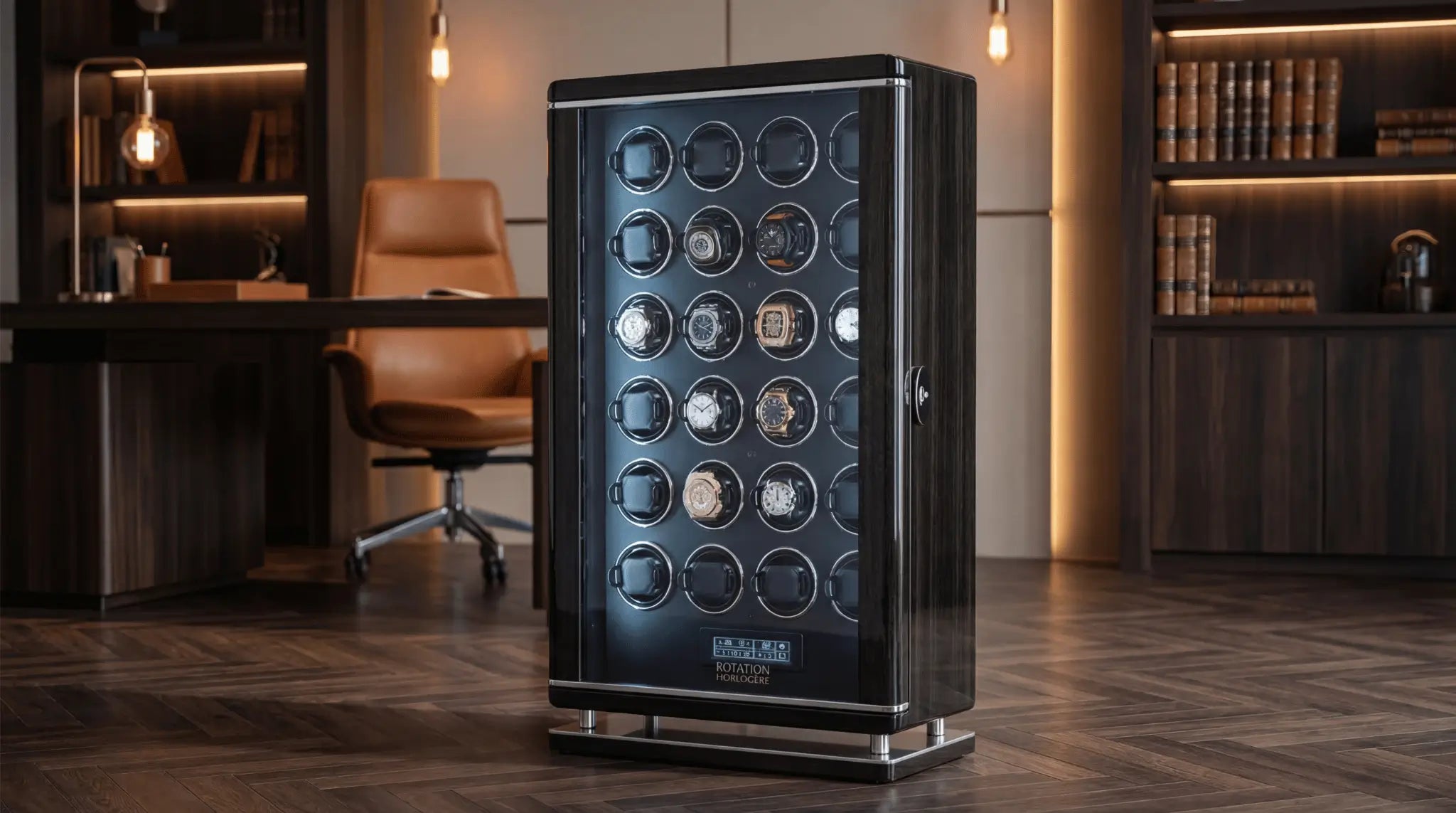
How to adjust the TPD on your automatic watch winder?
Have you just purchased an automatic watch winder and are wondering about the correct Turns Per Day (TPD) setting? Or does your watch stop despite the winder, or conversely, does it run constantly without ever seeming to stabilize? TPD setting is the most important step after purchasing a watch winder — yet it's the least well-documented in English.
This guide explains exactly how to identify if your watch winder is incorrectly set, how to correct it, and what values to apply depending on your watch.
What is TPD and why is it important?
TPD (Turns Per Day) refers to the number of full rotations performed by your watch winder's platform in 24 hours. This movement simulates wearing the watch on the wrist and keeps your automatic watch's mainspring under tension.

An inappropriate setting has two possible consequences:
Too few TPD — the mainspring is not sufficiently wound. Your watch loses accuracy, slows down, or even stops if left unworn for long periods. Complications (moon phase, perpetual calendar, GMT) desynchronize and require manual winding.
Too many TPD — the mainspring is constantly at full tension. The rotor's disengagement mechanism compensates, but excessive and continuous stress generates premature wear of components in the long term. This is not an immediate risk, but it's unnecessary and suboptimal.
The correct setting is one that keeps your watch at full charge without excess — generally between 650 and 1000 TPD depending on the caliber.
How to tell if your watch winder is incorrectly set?

Signs of too low TPD
Your watch loses minutes every day despite the winder. It stops if you don't wear it for 24 to 48 consecutive hours. After a weekend without wearing it, you have to manually wind it before putting it on your wrist. Self-winding complications (moon phase, perpetual calendar) regularly go out of sync.
Signs of too high TPD
In practice, too high TPD does not manifest any visible short-term symptoms — which is precisely why many owners leave their winder on full without thinking about it. The only indicator is a slight overheating of the motor on entry-level devices, or a slightly louder noise during continuous operation.
The power reserve test
The simplest way to check that your setting is correct: place your watch on the winder for 24 hours, then remove it. It should maintain its full power reserve without being worn — 38 hours for a standard Rolex, 48 hours for a recent caliber, 72 hours or more for watches with a large power reserve. If it stops before, increase the TPD.
How to set the TPD on your watch winder?
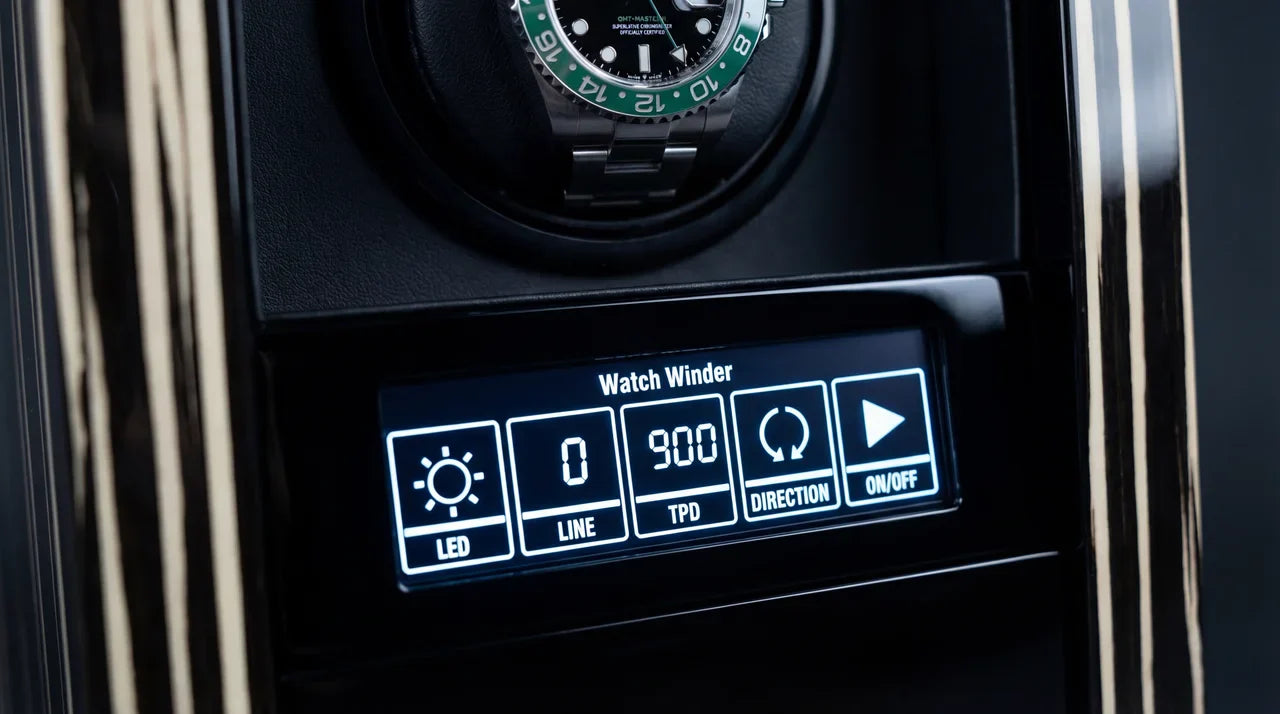
The setting method varies depending on the watch winder model. On most Rotation Horlogère winders, three parameters are adjustable:
Rotation direction — clockwise (CW), counter-clockwise (CCW), or bidirectional (Both). Most modern automatic watches operate bidirectionally. Some notable exceptions: the Rolex Daytona caliber 4130 is clockwise only, some Seiko calibers are counter-clockwise only. Consult our Rolex TPD guide for details by reference.
The number of TPD — generally adjustable in increments: 650, 750, 850, 1000, 1200, 1500, 1800, 2100 depending on the models. Always start with the value recommended by your watch manufacturer. In the absence of precise data, 800 TPD bidirectional is a conservative and universal setting compatible with almost all automatic calibers.
Activity/pause cycles — some winders allow you to program rest periods. This is useful for simulating natural wrist wear, which alternates between activity and immobility. On our Héritage, Président, and Chancelier models, these cycles can be programmed individually per slot.
Reference TPD values by major brand
| Brand | Recommended TPD | Rotation direction |
|---|---|---|
| Rolex (standard calibers) | 650–850 | Bidirectional |
| Rolex Daytona cal. 4130 | 800–950 | Clockwise only |
| Rolex Sky-Dweller | 800 | Bidirectional |
| Omega (Co-Axial calibers) | 650–800 | Bidirectional |
| Tudor | 650–800 | Bidirectional |
| Tag Heuer | 650–900 | Bidirectional |
| Seiko (NH35, NH36) | 650–800 | Bidirectional |
| Cartier | 650–800 | Bidirectional |
| IWC | 650–900 | Bidirectional |
| Panerai | 650–750 | Bidirectional |
| Breitling | 650–900 | Bidirectional |
| Patek Philippe | 650–800 | Bidirectional |
| Audemars Piguet | 650–800 | Bidirectional |
| Recommended universal setting | 800 | Bidirectional |
For complete data by Rolex reference, consult our Rolex TPD page — an exhaustive table of over 70 references with exact rotation direction and TPD.
Special cases: watches with long power reserve
Watches with a power reserve greater than 72 hours — Panerai Luminor (72h), IWC Portugieser (7 days), some Jaeger-LeCoultre — have a large capacity mainspring. They require fewer TPD to stay charged, and excessive winding unnecessarily stresses the disengagement mechanism.
For these watches, lower the TPD to 500–650 and observe the power reserve over 48 hours. If it holds without issue, the setting is correct. There's no need to go higher.
Conversely, watches with multiple complications (tourbillon, perpetual calendar, moon phase, minute repeater) consume more energy and may require a slightly higher TPD than average to stay synchronized. Gradually increase in increments of 100 TPD until stabilized.
Which watch winder for precise TPD setting?
Not all watch winders are equal in terms of setting precision. An entry-level winder with fixed positions does not allow for sufficient fine-tuning for demanding calibers. For truly precise TPD setting, you need a winder with individual adjustment per slot — rotation direction, TPD, and activity/pause cycles configurable independently for each watch.
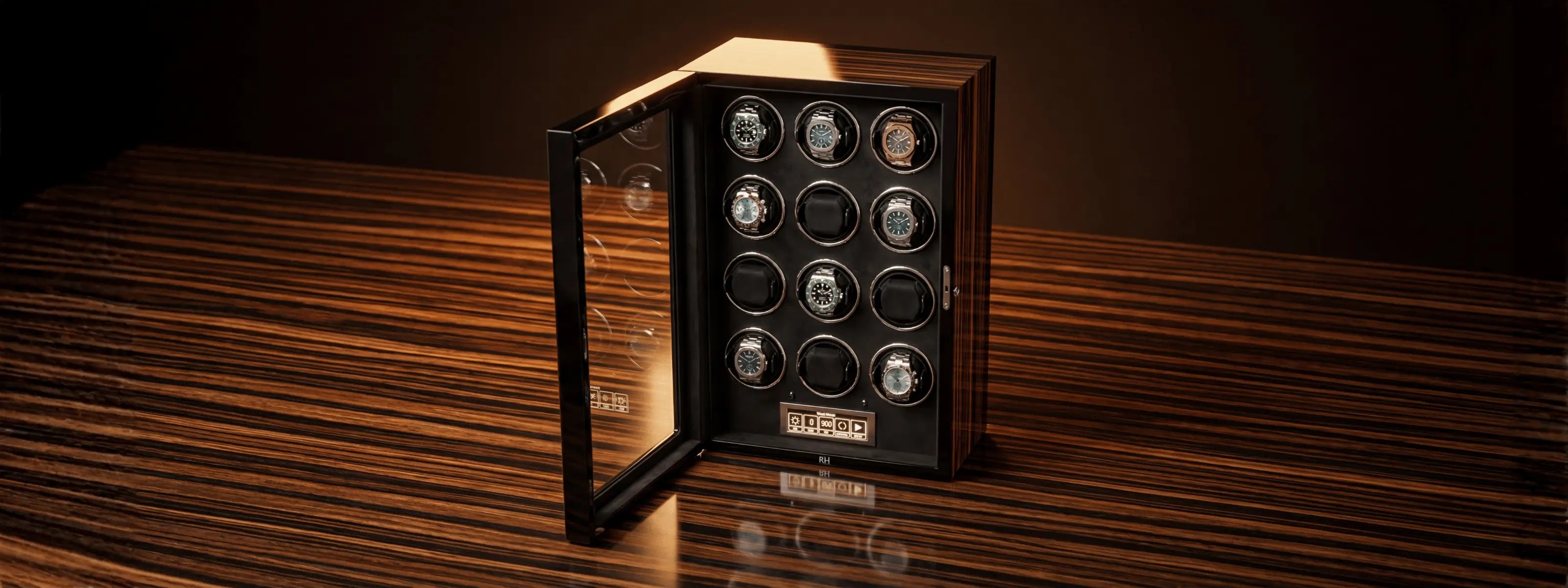
All Rotation Horlogère winders listed below meet this criterion: each slot can be programmed independently, whether you have 1, 2, 12, or 24 watches.
For 1 to 2 watches. The Héritage, Président, Chancelier, and Ambassadeur ranges are available from 2 slots upwards, with individually programmable TPD, rotation direction, and cycles. Ideal if you alternate between a Rolex Daytona (clockwise, 900 TPD) and a Panerai (bidirectional, 650 TPD) for example.
For up to 12 watches. These same ranges go up to 12 slots, each independently configurable. Every watch in your collection rotates according to its own parameters without any compromise.
For up to 24 watches. The Diplomate accommodates 24 watches with the same logic of individual programming per position — the solution for large collections.
For collectors with security requirements. The Bellagio™, Bellagio Pro™, and Bellagio Max™ watch winder safes combine individual programming, setting memory after power cuts, and complete physical protection of the collection.
For absolute demands. The Vauban™ represents the ultimate level: 12 slots, fine programming per position, customized activity/pause cycles, and integrated jewelry drawers within a solid steel structure.
Frequently asked questions about TPD setting
Can I leave my watch winder on the same setting for all my watches?
Technically yes, if you use 800 TPD bidirectional — this is the universal setting that suits 95% of automatic calibers without risk. But if you own a Daytona caliber 4130 (clockwise only) or a watch with a long power reserve, a dedicated setting is preferable.
My watch winder doesn't show a precise TPD value — how do I know what it's doing?
Some entry-level winders indicate modes (L/M/H or 1/2/3) without explicit TPD values. As a general rule: low mode ≈ 600–700 TPD, medium mode ≈ 900–1000 TPD, high mode ≈ 1500–1800 TPD. The medium mode is sufficient for most watches. Consult the manual or contact the manufacturer for exact values.
Do I need to change the setting according to the seasons?
No. Recommended TPDs are independent of temperature or season. However, if you wear your watch more or less regularly depending on the period, adjust accordingly: when worn daily, a watch only needs 500–650 TPD to stay charged via the winder in addition to wearing. If left unworn for several consecutive days, increase to 800–1000 TPD to compensate for the lack of wrist movement.
Can too high a TPD setting damage my watch?
Not in the short term. The disengagement mechanism of automatic watches protects the mainspring from overwinding. In the very long term, continuous and excessive stress on the rotor and winding click can accelerate wear — but this is measured in decades, not months. Stay within the recommended range and you'll have no problems.
To learn more, consult our complete TPD guide by Rolex reference, or explore our collection of automatic watch winders with precise TPD settings.
This article is part of our series of technical guides on maintaining and storing automatic watches.

Written by Bastien Jaffre
Fondateur de Rotation Horlogère, expert en remontage automatique et accessoires horlogers haut de gamme. Depuis plusieurs années, il accompagne les passionnés de montres dans le choix de leurs remontoirs et coffrets, avec une approche rigoureuse centrée sur la technique et la qualité.
%20setting?%20Or%20does%20your%20watch%20stop%20despite%20the%20winder,%20or%20conversely,%20does%20it%20run%20constantly%20...)
Leave a comment
This site is protected by hCaptcha and the hCaptcha Privacy Policy and Terms of Service apply.