


My automatic watch stops even with a watch winder: causes and solutions
You've invested in a watch winder so you never have to manually wind your watches again — yet your automatic watch still stops. This is one of the most frustrating situations for a watch enthusiast. Rest assured: in the vast majority of cases, the problem is identifiable and correctable without needing a watchmaker.
This guide reviews all possible causes, from the simplest to the most complex, and the solutions to apply in each case.
Cause #1: The TPD is too low for your watch
This is by far the most common cause. Every automatic movement requires a minimum number of turns per day to stay fully charged. If your watch winder rotates too slowly, it doesn't adequately compensate for the energy consumed by your watch — and the mainspring eventually runs down.
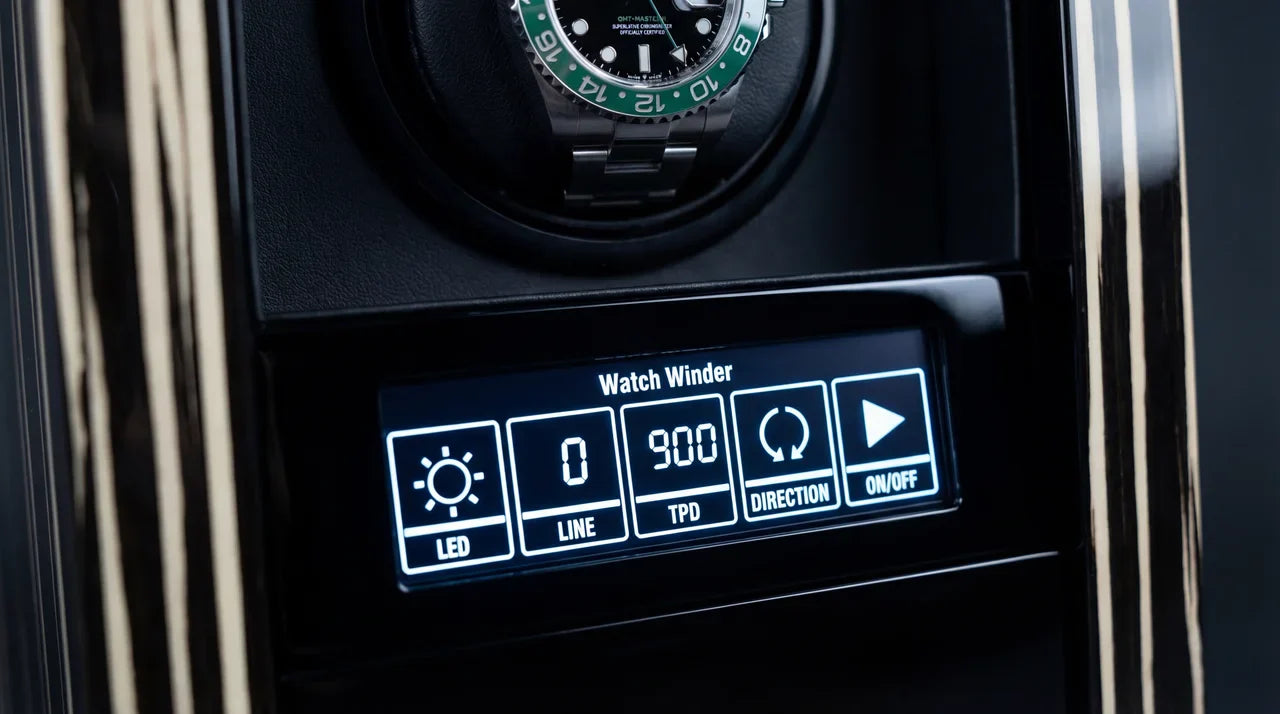
The solution is simple: increase the TPD in increments of 100 until your watch maintains its full power reserve after 24 hours on the winder. Most automatic watches require between 650 and 900 TPD. Consult our TPD guide by reference for exact values according to your brand and model.
Cause #2: The direction of rotation is incorrect
Some calibers only wind in one direction. A bi-directionally set winder for a watch that exclusively requires clockwise rotation only performs half of the useful work — the other half of the rotations do not wind the mainspring.
The most well-known example: the Rolex Daytona equipped with the 4130 caliber, which winds exclusively in clockwise (CW) rotation. If set bi-directionally, it will receive approximately half the necessary energy and will eventually stop. Check your caliber's specifications and adjust the direction of rotation accordingly.
Cause #3: Your watch has a very long power reserve
Paradoxically, some watches with a long power reserve — 72 hours, 7 days, or even more — can stop on an incorrectly configured winder. Their large capacity mainspring takes more time to charge and discharge. If the winder operates in short cycles with long pauses, the watch can run down between winding sessions without you realizing it.
For these watches, increase the TPD and reduce the pause cycles. The goal is to maintain the mainspring at a constant charge level, not to wind it up and then let it run down between sessions.
Cause #4: The cushion is unsuitable for your watch size
A cushion that is too small for your watch case will not hold the watch correctly. The watch will wobble, tilt, or even partially come out of its slot during rotation. The result: the crown or case back rubs against the internal walls, creating resistance that eventually blocks rotation or damages the watch.
Ensure your watch is held securely, without play, and that the cushion matches your case diameter. Most high-end watch winders offer several interchangeable cushion sizes.
Cause #5: The winder motor is faulty
A winder may appear to be working — light on, tray spinning — while still delivering insufficient rotation. An aging or poor-quality motor can lose torque, slow down gradually, or even stop intermittently without you noticing.
The test: lightly place your hand on the rotating tray. You should feel constant and regular resistance. Hesitant, jerky, or easily stoppable rotation indicates a faulty motor. In this case, the winder must be repaired or replaced.

Cause #6: Your watch needs servicing
If none of the previous causes apply to your situation, the problem may be with the watch itself, not the winder. Watch oils degrade over time — typically after 5 to 7 years depending on manufacturers. Aged oils create internal resistance that prevents the mainspring from winding correctly, even with a perfectly set winder.
In this case, a complete overhaul by an authorized watchmaker is necessary. After servicing, your watch will regain its full winding capacity and operate normally on your winder.
Cause #7: The watch has been magnetized
A magnetized hairspring is one of the most overlooked causes of unexpected stops. The hairspring is the component that regulates the watch's accuracy — when magnetized, it sticks to itself, loses its regularity, and can cause random stops even when operating on a winder.
Common sources of magnetism: electronic devices, speakers, bags with magnetic closures, bedside tables equipped with wireless chargers. An unshielded winder can itself magnetize your watch over time.
Diagnosis is simple: a watchmaker tests for magnetization in a few seconds with a detector. Demagnetization takes less than a minute and is usually free or inexpensive. Rotation Horlogère winders incorporate electromagnetic shielding compliant with IEC 60068-2-10 to prevent this problem during permanent use.
Checklist: What to check first
If your watch stops on a winder, check in this order:
1. The TPD — increase by 100 and observe over 48 hours.
2. The direction of rotation — check your caliber's specifications.
3. The cushion — the watch must be held firmly without play.
4. The motor — test the resistance of the rotating tray.
5. Magnetization — have it tested by a watchmaker if previous points are correct.
6. Servicing — if the watch is more than 5 years old without maintenance.
Which winder to choose to avoid this problem?
Most of the problems described in this article disappear with a quality, correctly configured watch winder. A winder with precise TPD settings, individually adjustable rotation direction per slot, and integrated electromagnetic shielding structurally eliminates the most frequent causes of unexpected stops.
The Héritage, Président, Chancelier and Ambassadeur ranges meet these criteria starting from 2 slots — each position is independently configurable for TPD, direction of rotation, and activity/pause cycles.
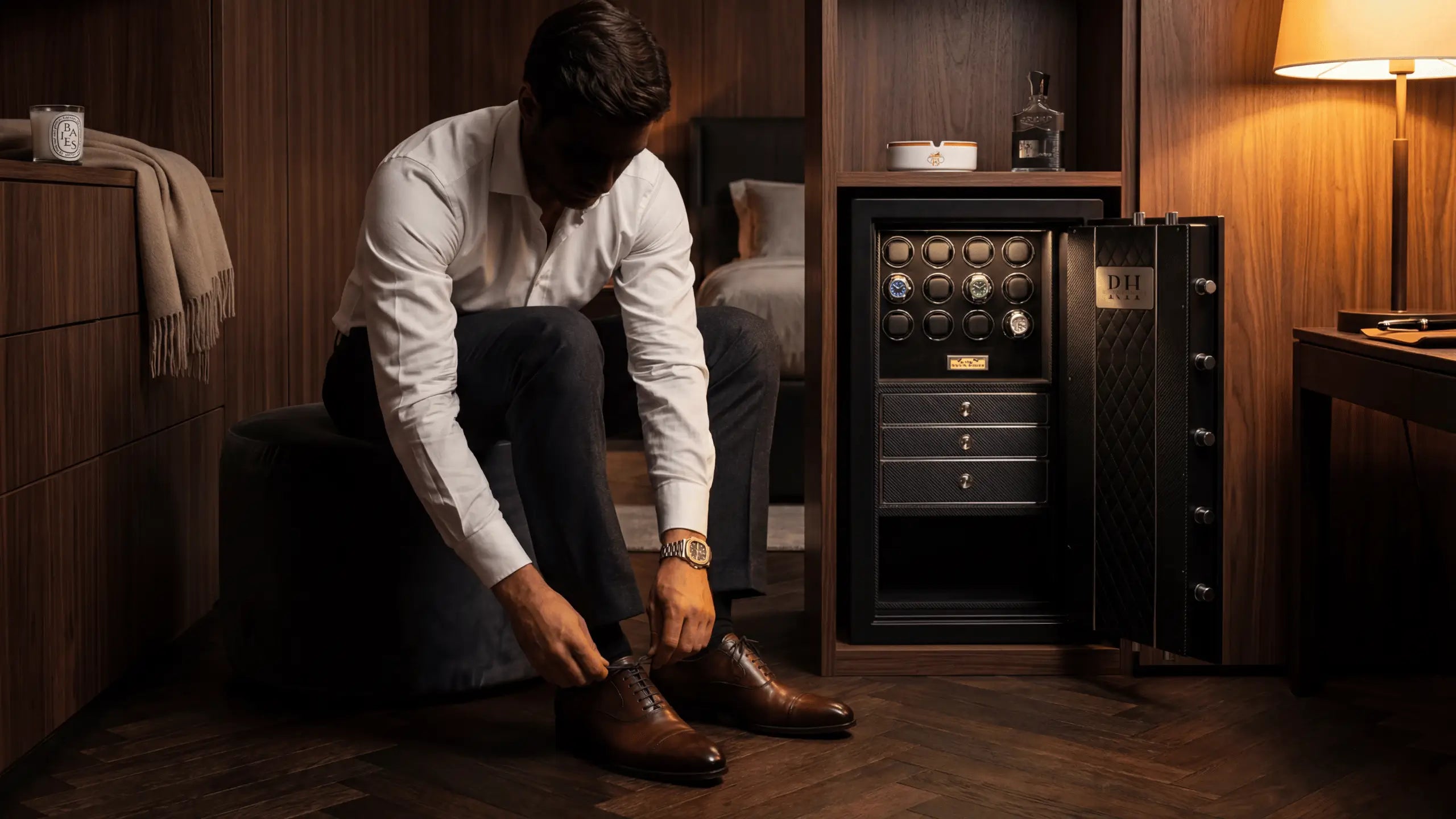
For important collections with security requirements, the Bellagio™, Bellagio Pro™ and Bellagio Max™ winder safes add complete physical protection — biometric lock, integrated alarm, armored walls.

Explore our complete collection of automatic watch winders or contact our team for personalized advice according to your watch and usage.
This article is part of our series of technical guides on the maintenance and storage of automatic watches.

Written by Bastien Jaffre
Fondateur de Rotation Horlogère, expert en remontage automatique et accessoires horlogers haut de gamme. Depuis plusieurs années, il accompagne les passionnés de montres dans le choix de leurs remontoirs et coffrets, avec une approche rigoureuse centrée sur la technique et la qualité.

Leave a comment
This site is protected by hCaptcha and the hCaptcha Privacy Policy and Terms of Service apply.