

Can you leave your automatic watch on a watch winder permanently?
It's one of the most frequent questions asked by new watch winder owners: should you remove your watch from time to time, or can it be left running indefinitely? The short answer is yes—but with some important nuances depending on your watch and your winder.
What Horological Mechanics Say
An automatic watch is designed to be worn continuously. Its winding mechanism incorporates a clutch device—called a safety click or torque limiter—which prevents the mainspring from being overwound. When the mainspring reaches its maximum charge, the rotor continues to turn freely without transmitting additional energy to the barrel.
This mechanism protects your watch from potential overwinding, whether from daily wear or from a watch winder. In theory, an automatic watch can therefore remain on a winder for as long as you wish without risk of damage related to overwinding.
In practice, the reality is a little more nuanced.
Benefits of Continuous Winding
Watch Oil Remains Fluid
This is the strongest argument in favor of continuous winding. Automatic watches use synthetic oils to lubricate the movement components—escapement, gears, rotor bearings. These oils have optimal viscosity when the watch is in motion. During prolonged stops, they tend to migrate, concentrating in the lower areas of the movement due to gravity, or even partially drying out on certain components.
A watch winder keeps the movement rotating continuously, which preserves the fluidity and homogeneous distribution of the oils—exactly as if you were wearing the watch every day.
Complications Remain Synchronized
For watches with complications—moon phase, perpetual calendar, GMT, power reserve—a prolonged stop means a tedious reset. Some complications, like the moon phase, require several minutes of manipulation to be precisely reset. A watch winder completely avoids this constraint: your watch is always on time, always synchronized, ready to be worn.
The Watch's Value is Preserved
A watch that never stops ages mechanically better than a watch that alternates stops and restarts. The jolts associated with repeated manual winding stress components differently from continuous, regular operation. For a collector's item or a horological investment, continuous winding is a practice recommended by most watchmakers.
Precautions to Take
Winder Quality is Crucial
A poor quality winder can paradoxically harm your watch. If the motor generates excessive vibrations, these are transmitted to the movement and can disrupt the most delicate components—especially the balance spring and escapement. A winder with a constant-torque Japanese motor, operating under 10 dB, eliminates this risk.
The Heritage, President, Chancellor, and Ambassador ranges are designed for permanent use—silent motorization, electromagnetic shielding, programmable activity/pause cycles.


The TPD Setting Must Be Correct
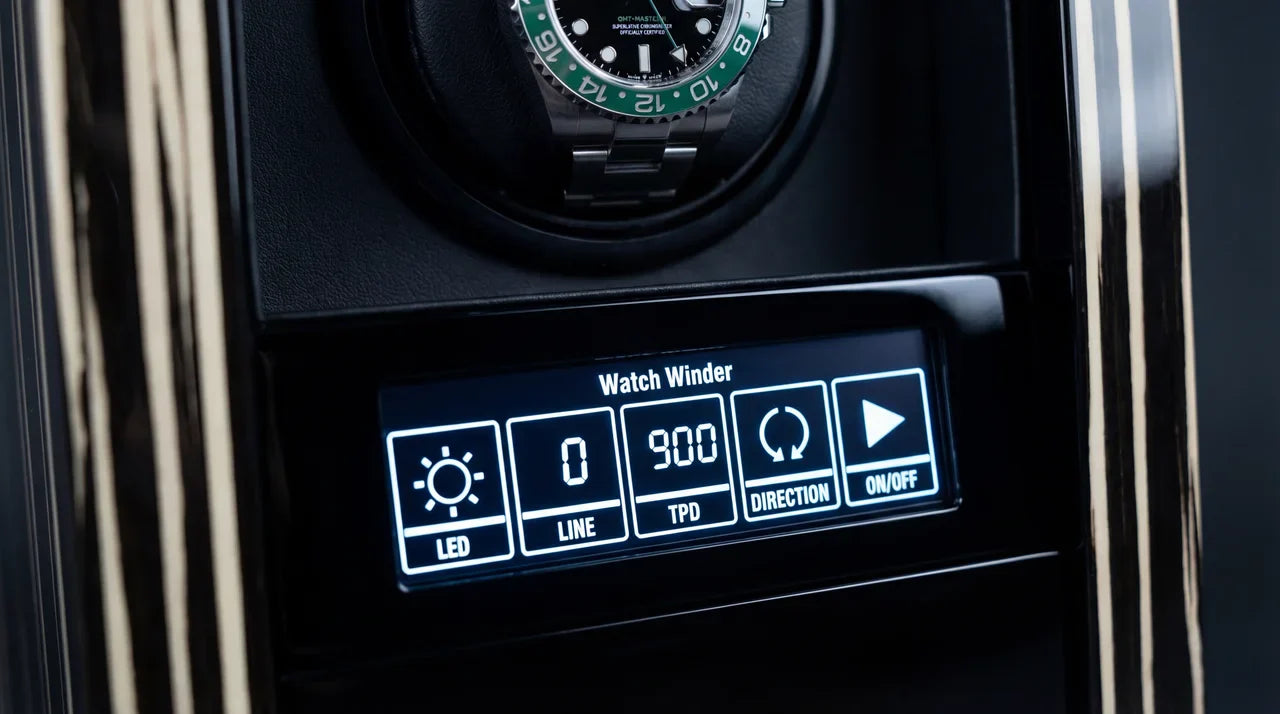
A winder set to an excessive TPD unnecessarily stresses the clutch mechanism continuously. Set your winder within the recommended range for your caliber—generally between 650 and 900 TPD. Consult our TPD guide by reference for exact values.
Magnetic Shielding is Essential
The electric motor of a winder generates an electromagnetic field. On unshielded winders, this field can, in the long run, magnetize certain movement components—especially the balance spring, which then loses its regularity. Rotation Horlogère winders incorporate shielded printed circuits compliant with IEC 60068-2-10, which neutralizes this risk even with permanent use.


Give Your Watch an Occasional Break
Even though continuous winding is perfectly safe on a good winder, some watchmakers recommend letting the watch discharge completely two to three times a year. This practice helps ensure that the mainspring retains its elasticity over the long term. This is not an obligation—it's more of a common-sense precaution for very precious pieces.
Special Cases: Watches That Should Not Remain Permanently on a Winder
Manual-Winding Watches Only
A winder is designed exclusively for automatic watches—those with an oscillating rotor. Manual-winding watches do not have a rotor and do not benefit from any protection against overwinding. Never place a manual-winding watch on a winder.
Old Watches with Degraded Lubricants
A vintage watch whose oils have not been replaced for more than 5 to 7 years should not be placed on a permanent winder before a complete overhaul. Old, degraded oils can form abrasive deposits when the movement runs continuously.
Watches Undergoing Break-in After Service
After a watch service, fresh oils require a few hours of wrist wear to stabilize. Avoid placing a freshly serviced watch directly on a winder without wearing it for a few days beforehand.
Permanent Winder or Daily Wear: Which to Choose?
If you wear your watch every day, the winder primarily serves to keep it on time at night and on weekends—an intermittent use that is perfectly suitable.
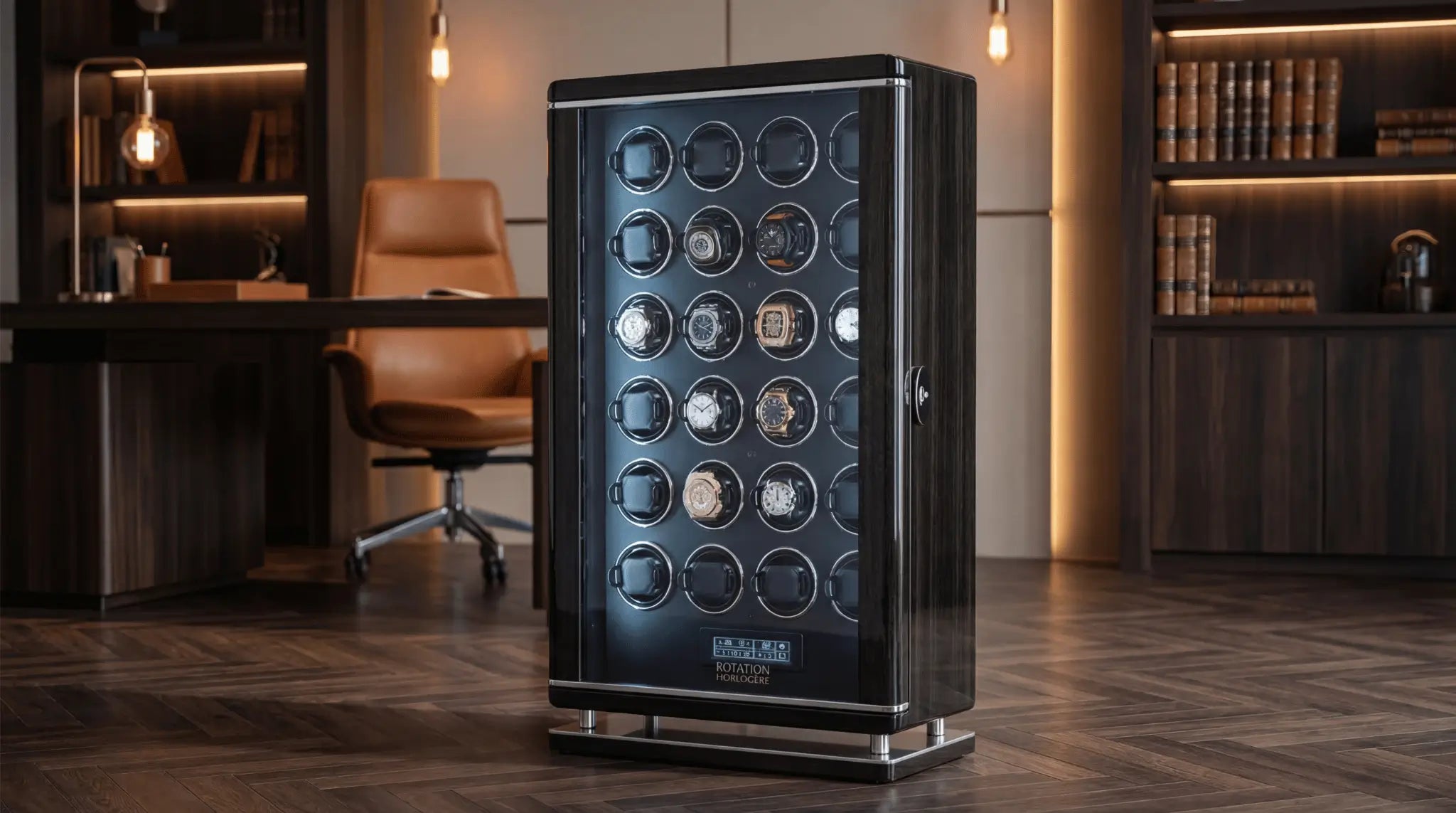
If you own several automatic watches and some remain unworn for several weeks, the permanent winder is the best solution to keep them in optimal working condition. It is precisely for this type of collector that our multi-position winders have been designed.
The Heritage and Ambassador accommodate up to 12 watches with individual programming per slot. The Diplomat can hold up to 24 positions for the largest collections.
For collectors who wish to combine permanent winding with physical security, our safe winders Bellagio™, Bellagio Pro™, Bellagio Max™, and Vauban™ are the obvious answer: your watches run continuously, protected behind a biometric lock, safe from theft and impact.
In Summary
Yes, you can leave your automatic watch permanently on a winder—provided the winder is of sufficient quality, correctly set, and equipped with electromagnetic shielding. This is even the recommended practice for collectors who alternate between several watches.
The only real precaution: choose a winder that works for your watch, not against it.
Discover our complete collection of automatic watch winders or our safe winders for permanent winding in complete safety.
This article is part of our series of technical guides on the maintenance and storage of automatic watches.

Written by Bastien Jaffre
Fondateur de Rotation Horlogère, expert en remontage automatique et accessoires horlogers haut de gamme. Depuis plusieurs années, il accompagne les passionnés de montres dans le choix de leurs remontoirs et coffrets, avec une approche rigoureuse centrée sur la technique et la qualité.


Leave a comment
This site is protected by hCaptcha and the hCaptcha Privacy Policy and Terms of Service apply.